Strategy-First Positioning: A Framework for Founders
If you've invested months in an agency relationship and still can't articulate what makes your brand genuinely different, that is a positioning problem. That distinction changes everything about how you solve it. The strategy-first positioning framework gives founders a structured path to build real differentiation before a single deliverable is produced. Most retainer engagements fail because they bypass this foundational layer entirely. They skip straight to producing content for a position that was never clearly defined.
This post is written for the founder who recognizes that specific frustration. The first three sections stand alone as a strategic resource. The framework is transferable and doesn't require any tool or platform to apply.
The Retainer Trap: Why Expensive Agency Models Often Fail Founders
There's a specific kind of frustration that sets in around month three of an agency engagement. Deliverables are arriving on schedule. The calendar is full. The reports show consistent activity.
But when someone asks what makes your brand different (in a pitch, at a conference, or in a cold email), you pause. You describe your product instead of why it matters. The content exists, but the differentiation is missing.
According to a HubSpot State of Marketing report HubSpot State of Marketing study, 61% of marketers cite generating qualified leads as their top challenge. Yet most marketing investment flows toward production volume rather than the positioning clarity that makes lead generation actually convert.
Why Expensive Retainers Fail to Differentiate Brands
Expensive retainers fail to differentiate brands because they're built around output delivery, not strategic foundation. Agencies bill for content calendars, ad spend management, and monthly reporting; activities that are measurable and contractually defined. Positioning strategy, which requires deep brand discovery and rigorous competitive analysis, typically isn't included because it's harder to scope and invoice.
The incentive structure is misaligned from the start. A retainer rewards consistency of production. A strategy-first approach rewards the clarity of foundation that makes production worth anything at all.
Many agencies do excellent execution work. The gap exists because founders often engage agencies expecting strategy to emerge from execution, and agencies rarely correct that assumption because doing so would threaten the engagement before it begins.
The result: a brand that is consistently present and consistently undifferentiated. More content about an unclear position, distributed more efficiently.
What a Strategy-First Positioning Framework Actually Means
A strategy-first positioning framework is a structured process for defining your brand's competitive position before investing in content, campaigns, or creative execution.
It resolves three questions most marketing briefs leave unanswered:
- Who, specifically, is this brand for? Identify a person in a specific situation with a specific urgency rather than a broad demographic.
- What singular claim of difference can this brand credibly own?
- What proof exists to make that claim believable to a skeptical buyer?
These strategic decisions shape all subsequent marketing and sales activities. They create clarity that compounds over time.
According to research from McKinsey brand strategy research McKinsey & Company, companies that maintain consistent brand positioning across channels see 10, 20% higher revenue growth than those operating without a coherent positioning strategy.
The Strategy-First Framework in Practice
In practice, a strategy-first positioning framework produces three outputs before any content is created: a positioning statement (a working document defining the audience, category, differentiation, and proof rather than a tagline), a competitive whitespace map (a structured view of competitor positioning and defensible space), and a core narrative architecture (the repeatable story connecting problem, solution, and proof across channels).
Each output is a decision document. It tells you what to say, who to say it to, and why that specific claim is ownable right now in your market.
Every subsequent asset (content, campaigns, sales decks, and outreach sequences) becomes a translation of that foundation rather than an independent invention. The framework is built once and applied continuously. It is applied continuously rather than revisited quarterly or reinvented for every campaign.
That distinction changes how you evaluate marketing investment entirely. The question stops being "did we publish consistently this month?" and becomes: "does everything we published trace back to the same defensible position?"
The Three Layers Every Brand Positioning Strategy Needs
Most positioning failures happen because founders treat differentiation as a single decision (usually a tagline or a niche statement) rather than as a layered framework where distinct components do distinct jobs.
The strategy-first model requires three layers. All three must be present for positioning to hold.
Layer 1: Audience Precision
The first layer defines not just who you serve, but the specific trigger moment that makes someone a qualified buyer right now. Demographics are a starting point, not the destination. The real question is: what has just happened in this person's business that creates the urgency and openness your solution requires?
According to Gartner B2B buyer behavior research Gartner's B2B buyer research, 77% of buyers describe their most recent major purchase as "very complex or difficult"; primarily because undifferentiated messaging from vendors claiming similar capabilities made comparison nearly impossible. Audience precision solves this from the supply side by making your message immediately recognizable to the right person at the right moment.
Layer 2: Claim Architecture
The second layer builds the differentiation claim and maps it against what competitors are already saying. A claim that overlaps with two direct competitors isn't differentiation. It is just well-designed noise.
Claim architecture means plotting the competitors across two axes: the specific audience segment targeted and the primary benefit claimed. This produces a whitespace map showing where genuine differentiation is available and defensible over time. The most durable claims occupy space that is both credibly ownable and practically difficult for competitors to replicate quickly.
Layer 3: Proof Infrastructure
The third layer (most frequently skipped) builds the proof structure that makes claims believable to a skeptical buyer who has already heard similar claims from three competitors.
Proof infrastructure has three components: category evidence (data and research validating the problem), social evidence (specific outcomes from specific customers, not generic testimonials), and authority evidence (proprietary methodology, original research, or credentials competitors cannot replicate). Without this layer, positioning is aspiration, not strategy.
Strategy-First vs. Content-First Marketing
Content-first marketing asks what to publish this month, generating volume. Strategy-first marketing asks what position you can own and defend, generating differentiation. The difference shows up in sales cycles. Brands with coherent positioning close deals faster because prospects self-qualify before engaging, arriving pre-sold on a specific claim rather than comparing on price.
According to Forrester content-to-revenue research Forrester Research, sales cycles shorten by an average of 18% when marketing and sales operate from a shared positioning foundation rather than disconnected campaign messaging.
How to Diagnose Whether Your Brand Has a Positioning Problem
A positioning problem is routinely misdiagnosed as a content problem, a sales problem, or a budget problem. The symptoms look similar from the outside. The solution is fundamentally different.
Four diagnostic signals point specifically to positioning as the root cause.
Signal 1: You win on relationships, not differentiation. If you cannot identify a single competitive deal won because of what makes your brand different (as opposed to who referred you), you have a positioning gap that relationships are temporarily papering over.
Signal 2: Prospects compare you on price. Price comparison is almost always a symptom of undifferentiated positioning. When prospects can't see clear difference between options, they default to cost as the deciding variable. That's a positioning failure, not a pricing problem.
Signal 3: Your content performs but your pipeline doesn't. Engagement metrics without conversion usually mean content is attracting broad interest without qualifying the right audience. That's a claim precision and audience targeting problem. It lives upstream of the content itself.
Signal 4: Describing your brand takes more than two sentences. If your explanation requires extensive context to land with someone new, your positioning hasn't crystallized. Effective positioning creates instant recognition instead of gradual understanding built across multiple interactions.
The Right Time to Invest in Brand Positioning
A founder should invest in brand positioning before scaling any marketing channel, not after achieving traction. The common mistake is treating positioning as a refinement exercise for brands that already have momentum, rather than the foundation that creates momentum. According to CB Insights startup failure analysis CB Insights, 35% of startup failures cite poor product-market fit as a primary cause. Undifferentiated positioning is frequently the communication layer of that same structural problem. The right moment is before you commit to repeatable marketing activity: content programs, paid acquisition, outreach sequences, or agency partnerships.
Positioning work done after these channels are running requires unwinding existing assumptions and retraining audience expectations, which is significantly more costly than building the foundation first.
The Cost Calculus: Retainer Spending vs. Strategic Foundation
This is the conversation most agency relationships avoid having explicitly. It's worth making the math visible for founders evaluating their current spend.
A typical B2B agency retainer runs between $5,000 and $15,000 per month. According to Agency Analytics industry benchmarks, the median monthly retainer for a full-service digital agency engagement is approximately $8,500. Over a 12-month engagement, that's $102,000.
The majority of that spend covers execution: content production, distribution management, platform reporting, and account coordination. The positioning foundation (if addressed at all) typically receives two to three weeks at the engagement's start before the agency shifts into production mode to justify the ongoing retainer.
The strategic foundation that should inform every dollar of that $102,000 investment often receives less than $2,000 in equivalent time and rigor.
The strategy-first model inverts this ratio deliberately. Upfront investment in foundation is heavier. The strategic foundation receives the depth and rigor required to hold under competitive pressure. The execution that follows is more efficient, more targeted, and more defensible because it emerges from a clear position rather than working toward one through accumulated content volume.
Measuring Positioning Success
Brand positioning is working when three things align: your best prospects describe their problem using your language before you introduce it to them, your close rate on qualified leads improves because prospects arrive pre-sold on your specific claim of difference, and your content generates pipeline rather than just engagement. According to LinkedIn B2B Institute distinctive brand research LinkedIn's B2B Institute, brands with strong distinctive positioning generate five times more mental availability in buyer decision moments than undifferentiated competitors in the same category.
If prospects are using your competitors' language to describe what they need (and evaluating you against that frame), your positioning hasn't taken hold yet. That's diagnostic information, not a content problem.
Applying the Strategy-First Positioning Framework to Your Brand
The framework is transferable. Here is how to begin the diagnostic work without an agency or external consultant involved.
Step 1: Audit your current claim. Write your current positioning claim in one sentence. Then check: does any direct competitor say something functionally identical on their homepage? If yes, you have a category description, not a differentiated claim. This reveals the precise gap that all subsequent work will address.
Step 2: Map your competitive whitespace. List your five closest competitors. For each, identify the primary benefit claim in their homepage headline and the primary audience segment they address explicitly. Plot them on a simple two-axis matrix. The open spaces on that matrix are your positioning opportunities, where you can make a credible claim that no current competitor is occupying.
Step 3: Pressure-test with proof. For your candidate positioning claim, ask: what specific evidence makes this claim credible and non-generic? Not testimonials that say "great to work with", but proof that validates the specific claim of difference you're making. If the proof doesn't exist yet, you're choosing between building it and revising the claim. Both are legitimate strategic decisions. Neither is a failure.
Step 4: Translate to narrative architecture. A positioning foundation only creates market value when it becomes a repeatable story. The narrative architecture has three movements: the problem your audience already recognizes as true (the problem they feel before finding you rather than the problem you solve), the reframe that makes your specific approach distinctively logical given that problem, and the proof that makes your claim credible to someone encountering it for the first time.
This four-step process produces a working positioning foundation in a single focused session. It provides enough clarity to honestly evaluate whether your current marketing investment is building on solid ground or spending efficiently toward an undifferentiated position.
Where Snappin Fits: The Implementation Layer
The framework above works independently of any tool or platform. If you've worked through it, you now have a clearer picture of your positioning foundation or its specific gaps.
Snappin platform overview Snappin is built as the implementation layer for founders and lean teams who have done the strategic work (or want to do it with structured expert guidance) and need an efficient path from positioning clarity to consistent content execution.
The platform is built around a strategy-first workflow: positioning development comes first, content production follows from that foundation, and every deliverable traces back to the core claim and audience precision the framework defines. Strategy isn't an onboarding checkbox before production begins. It's the operating layer that makes production worthwhile.
For founders who have experienced the retainer cycle of spending consistently without accumulating a defensible position, Snappin represents a fundamentally different structural model. The practical entry point is a positioning audit. This structured session applies the framework to your current brand and produces the three foundation documents most retainer engagements never deliver.
The Strategic Foundation Is the Competitive Advantage
Here is the central insight of the strategy-first positioning framework: most of your competitors are spending heavily on execution while neglecting foundation. That neglect is a structural opportunity, and it costs nothing to exploit except the discipline to build the foundation first.
A brand with a clear, defensible position (even with modest content volume) will consistently outperform a brand with high output and an undifferentiated claim. This rule applies to any category, budget, or team size.
The future where strategic marketing is accessible to every founder isn't a distant aspiration. For the founders who invest in the right foundation first, it's already the present. The distance between where you are now and where that clarity takes you is shorter than most retainer models would have you believe.
Three concrete next steps worth taking before that future becomes yours:
- Run the four-step audit outlined above and write down your current positioning claim alongside the specific proof that supports it. The gap between those two things is your positioning problem, precisely defined.
- Map your competitive whitespace using your five closest competitors' homepage claims as your dataset. You need two hours and a spreadsheet, not an agency.
- Evaluate your current marketing investment against one question: does every deliverable you're receiving trace back to a defined positioning foundation? If not, you now know exactly what's missing and exactly what to build before spending another month on execution.
The founders who build the right foundation first don't just market better. They compete differently, and that difference compounds.
Snappin Team
Strategy-first marketing insights from the team building Snappin — the AI Marketing Copilot that combines strategy, content creation, and scheduling in one platform.
Try Snappin freeContinue Reading

The Mechanics of Reach: A Strategic Guide to Social Media Algorithms
If you want consistent reach, stop looking for "viral hacks." Building a real brand on social media isn't about winning a lottery; it’s about understanding how the platforms actually work.
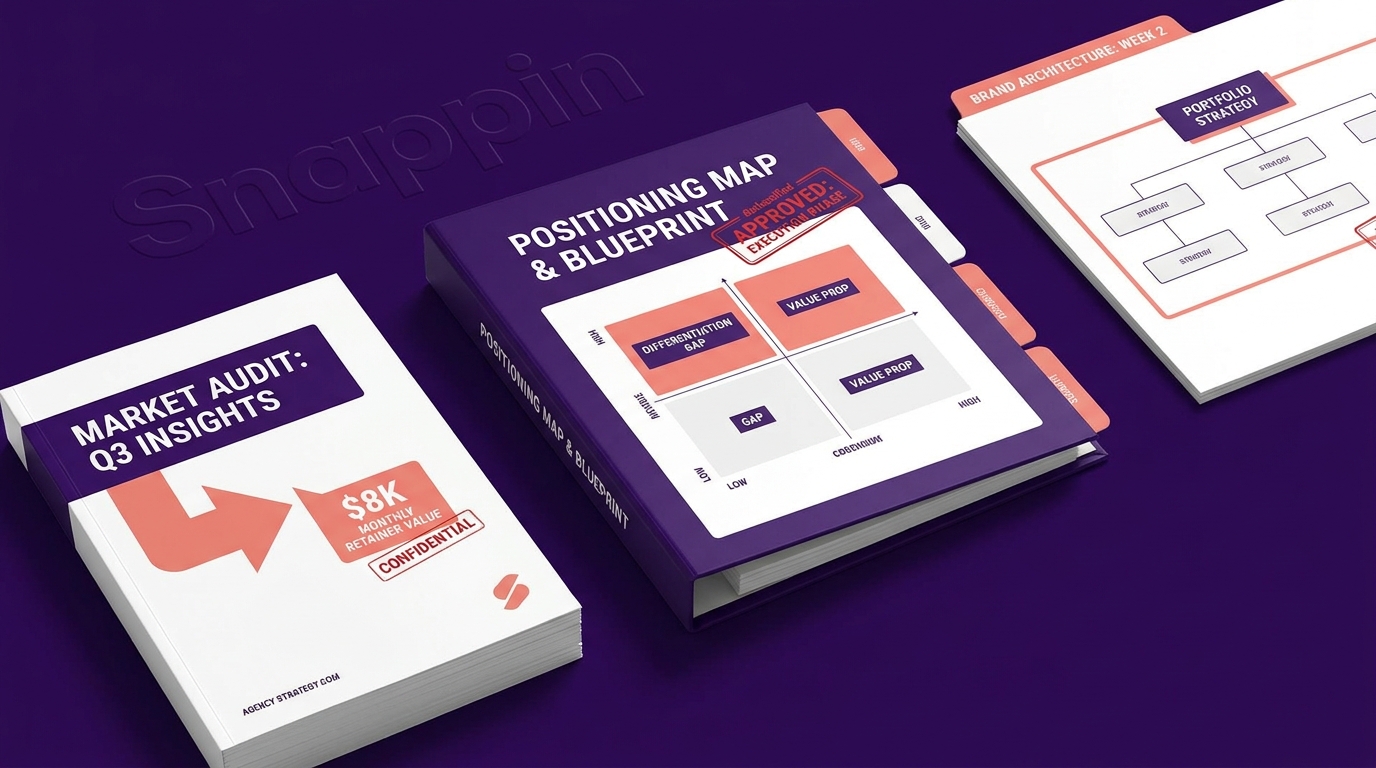
Brand Strategy Retainer: The Agency Deliverables You're Actually Paying For
A brand strategy retainer at $8k, $15k/month is built on five core deliverables: market research methodology, positioning framework, brand architecture, competitive analysis, and expression system. These are specific frameworks agencies have spent years productizing, rather than vague consulting hou
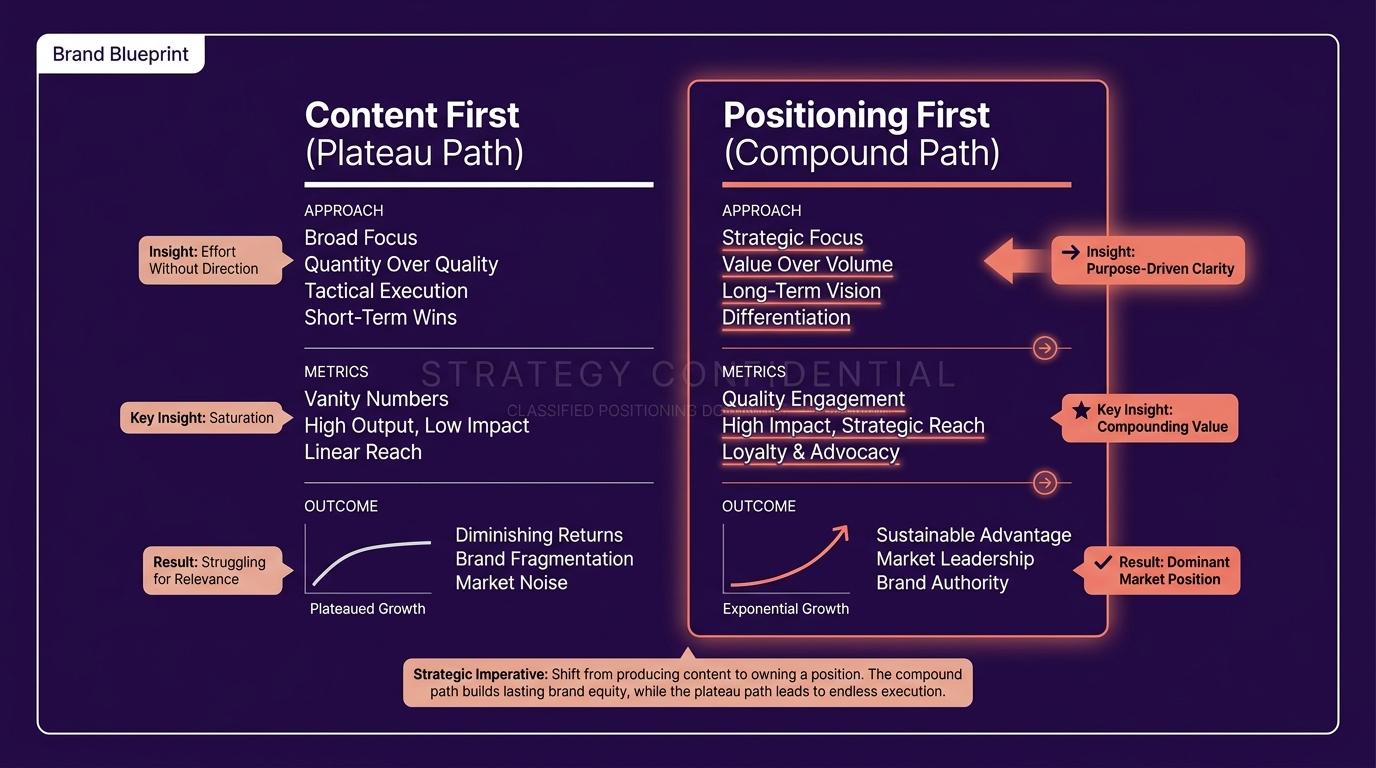
Brand Positioning Before Content: Why Some Brands Compound
Most founders are producing more content than ever and building far less audience trust than they expected. That gap is the predictable result of building in the wrong order, and it closes the moment you change the sequence.