Brand Strategy Retainer: The Agency Deliverables You're Actually Paying For
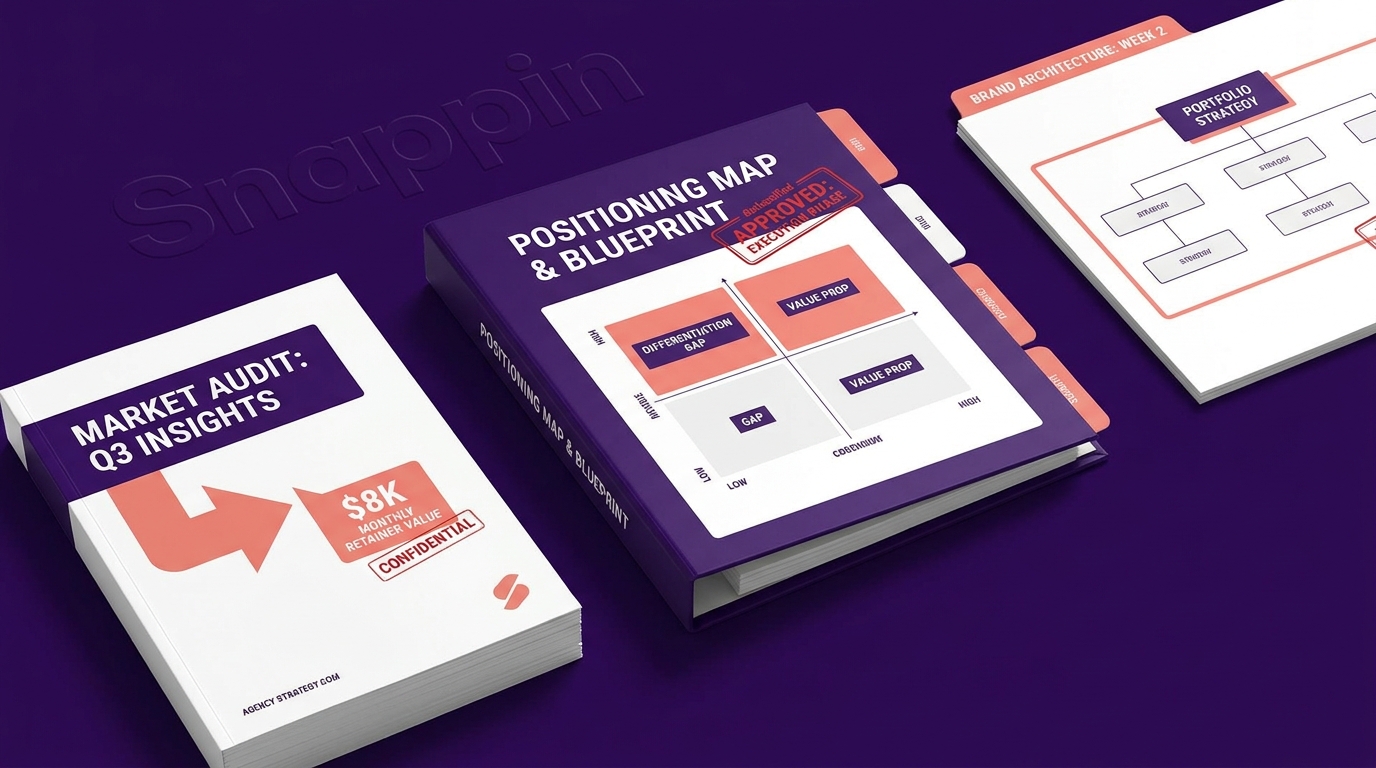
A brand strategy retainer at $8k, $15k/month is built on five core deliverables: market research methodology, positioning framework, brand architecture, competitive analysis, and expression system. These are specific frameworks agencies have spent years productizing, rather than vague consulting hours. Once you know their names, the price stops feeling arbitrary. Once you know their structure, the path forward becomes clear regardless of your budget.
Most founders who've been burned by an agency bill share the same post-mortem: "I'm not sure what I paid for." Strategy deliverables are complex. The real problem is that most firms don't walk clients through the ingredient list before the invoice arrives. Knowing what's in the stack changes everything.
This post names each deliverable with the exact terminology agencies use internally, shows the actual time cost behind each one, and explains why the math reaches five figures a month. It hands you the blueprint so you can work with it, not just pay for it.
What Brand Strategy Agencies Actually Deliver
"Brand strategy" sounds like a single thing. In practice, it's a stack of five to seven distinct work products, each with its own methodology, tool set, and delivery format.
According to a 2023 survey by the Agency Management Institute, the average mid-market brand strategy engagement requires between 120 and 180 billable hours to complete the initial foundation phase. Agency Management Institute survey At a blended agency rate of $150, $200/hour, standard for firms with senior strategists on staff, that's $18,000, $36,000 in labor before a single asset ships.
Monthly retainers don't restart that work from zero each month. They maintain it: refreshing research, pressure-testing positioning against new market signals, extending the expression system as the brand grows. The retainer is the operating cost of keeping the strategic foundation current. Now you understand exactly what's running under the hood.
The Actual Deliverables of a Brand Strategy Agency
A brand strategy agency delivers a set of interconnected strategic documents: a market research synthesis, a positioning framework, a brand architecture, a competitive analysis, and a visual and verbal expression system. Each document answers a different foundational question about where a brand sits, what it stands for, and how it communicates. These documents govern execution rather than replace it. Every campaign, product page, and sales script is supposed to derive from these upstream decisions.
The Market Research Methodology Layer
The first deliverable agencies produce is a methodology rather than a document. Before any positioning statement gets written, a research protocol is established: which customer segments to interview, which secondary data sources to synthesize, and which signal types (search behavior, category spending, competitor sentiment) to weight most heavily.
According to Nielsen's 2023 Annual Marketing Report, brands that base positioning decisions on structured qualitative research outperform those using assumption-based positioning by 41% in first-year customer retention rates. Nielsen Annual Marketing Report That gap compounds: a positioning framework built on assumptions erodes faster because it was never calibrated to actual customer language in the first place.
What this deliverable includes:
- Customer interview guide (12, 20 semi-structured questions per segment)
- Segment hypothesis documentation
- Secondary research synthesis (category data, TAM/SAM/SOM analysis)
- Jobs-to-be-done mapping across 3, 5 customer archetypes
- Research findings report with strategic implications
Approximate time cost: 25, 40 hours per engagement cycle. At agency rates, this layer alone represents $3,750, $8,000 in labor.
The research methodology isn't a one-time expense. Agencies run abbreviated refresh versions quarterly to catch category drift, the slow shifts in customer language, competitive positioning, and purchase drivers that erode brand relevance if left unmonitored. This is the intelligence layer. Every strong positioning decision is downstream of it.
The True Timeline for Brand Strategy Research
The initial research phase typically takes three to five weeks. This includes designing the research protocol, recruiting and interviewing customers, synthesizing secondary data, and producing the findings report with strategic implications. Shortcuts at this stage are the most common reason positioning frameworks fail. They get built on assumption rather than evidence, and no amount of creative execution fixes a foundation poured in the wrong place.
Positioning Framework: The Core Brand Strategy Deliverable
The positioning framework is the deliverable most clients think they're buying when they sign a strategy retainer. It's the document that names your brand's place in the market: who it's for, what category it competes in, what makes it different, and why that difference matters to a specific buyer.
Agencies deliver this as a structured document containing four to six components. The exact terminology varies by firm, but the underlying architecture is consistent across the industry. Now you know the architecture too.
Standard positioning framework components:
- Category definition: How you define the competitive frame your brand operates within
- Target customer profile: A behaviorally and psychographically specific description of the primary buyer
- Point of difference (POD): The single most defensible reason to choose your brand over alternatives
- Reason to believe (RTB): The proof architecture that makes the POD credible
- Brand essence: A single phrase capturing the emotional core of the brand
- Positioning statement: The formal synthesis: "For [audience] who [need], [brand] is the [category] that [POD] because [RTB]."
According to research by McKinsey & Company, companies with clearly articulated brand positioning grow revenue 2x faster than those without a defined framework, across consumer and B2B categories. The framework functions as the decision filter for every downstream marketing choice, rather than acting as a decorative element.
Approximate time cost: 30, 50 hours to build and validate. This includes multiple rounds of internal review, client alignment sessions, and stress-testing the POD against competitive alternatives. That's $4,500, $10,000 in agency labor for this deliverable alone.
The Mechanics of a Brand Positioning Framework
A brand positioning framework is a structured document that defines exactly where a brand sits in its market: who it serves, what it uniquely offers, and why customers should believe that claim. It serves as the governing logic for all downstream marketing decisions, from campaign messaging to product naming to sales scripts. The framework serves as the strategic reasoning that a tagline expresses. It is something every founder can have, not just the ones writing $10k checks.
Brand Architecture and the Expression System
Brand architecture and the expression system are two separate deliverables that agencies frequently bundle together. Understanding the distinction is the difference between knowing what you bought and being certain you got it.
Brand architecture defines the structural relationships between your brand and any sub-brands, product lines, or service tiers. Even for early-stage companies with a single product, architecture decisions have compounding consequences. Naming a feature in a way that forecloses future architecture options is a recoverable mistake, but an expensive one.
According to Forrester Research, 72% of brand architecture problems that require costly consultants to fix trace back to naming and structural decisions made in the first 18 months of a company's life. The architecture deliverable is preventive infrastructure. The founders who invest in it early are the ones who never have to pay to undo it later.
Brand architecture deliverable includes:
- Brand hierarchy documentation (master brand vs. endorsed brand vs. sub-brand relationships)
- Product and feature naming conventions
- Naming architecture guardrails for future extensions
- Portfolio logic documentation (if applicable)
The expression system translates the positioning framework into the tangible signals audiences actually encounter. Agencies also call this the "brand identity system" or "visual and verbal identity system."
Expression system components:
- Verbal identity: tone of voice guidelines, vocabulary list, messaging hierarchy by audience and channel
- Visual identity: logo system, color palette, typography, photography and illustration direction
- Brand voice examples across key touchpoints (website hero, sales deck, social bio)
- Usage guidelines (the internal document sometimes called the brand bible)
According to Lucidpress, brands that maintain consistent visual and verbal expression across all touchpoints see revenue increases of 10, 20% compared to brands with inconsistent application. The expression system is what makes consistency possible at scale without policing every decision manually. It's how a brand that starts in one room runs the same way across fifty.
Approximate time cost combined: 40, 60 hours for a foundational expression system. This is where most of the visible creative work lives; $6,000, $12,000 in agency hours.
Components of a Brand Architecture Deliverable
A brand architecture deliverable maps the structural relationships between a company's master brand and all sub-brands, products, services, and future extensions. It establishes naming conventions, defines when a new product gets its own identity versus borrows equity from the parent brand, and documents the decision logic so future teams can make consistent choices without starting from scratch. Most early-stage companies don't think they need this until a naming decision creates a mess that costs more to untangle than the original architecture would have.
Competitive Analysis: The Ongoing Brand Strategy Work
Competitive analysis is the deliverable that most justifies the retainer model. It is also the one that most founders underestimate until positioning starts to feel stale.
Rather than a product feature comparison, a brand strategy competitive analysis maps competitor positioning claims, communication tone, visual language, and audience targeting to identify white space: the territory no competitor currently owns in the customer's mind. That's what you're actually trying to find.
What a brand strategy competitive analysis includes:
- Competitor positioning audit (analyzing 5, 10 direct and indirect competitors)
- Messaging gap analysis (what's being said across the category vs. what's conspicuously absent)
- Visual language audit (color, typography, and imagery conventions that define category codes)
- Perception mapping (plotting competitors on key attribute axes to visualize white space)
- White space identification report with strategic recommendations
According to Crayon's 2023 State of Competitive Intelligence Report, the average company faces meaningful competitive messaging changes every 3, 5 months. Agencies refresh competitive analysis quarterly to keep positioning frameworks from becoming stale as competitors reposition around them.
Approximate time cost: 15, 25 hours per quarter. At agency rates: $2,250, $5,000 per refresh cycle.
This is the deliverable founders most often skip. It is also the one whose absence most visibly ages a brand's positioning within 12 months. A positioning framework built against a market that no longer exists is a liability, not an asset. The market moves. Your analysis has to move with it.
Why Brand Strategy Retainer Costs Add Up
A single engagement cycle (where an agency builds all five deliverables from scratch) represents 110, 175 hours of senior strategist and creative director time. At blended rates of $150, $200/hour, the first-build cost runs $16,500, $35,000.
Agencies don't typically charge that as a one-time fee. They amortize it across a 6, 12 month retainer, then continue charging for maintenance: research refreshes, positioning pressure-tests, expression system extensions, and competitive analysis updates.
Monthly retainer cost breakdown (approximation):
| Deliverable | Monthly Hours | Est. Monthly Cost |
|---|---|---|
| Market research maintenance | 5, 8 hrs | $750, $1,600 |
| Positioning framework refinement | 4, 6 hrs | $600, $1,200 |
| Brand architecture governance | 2, 4 hrs | $300, $800 |
| Expression system extensions | 8, 15 hrs | $1,200, $3,000 |
| Competitive analysis refresh | 6, 10 hrs | $900, $2,000 |
| Strategic advisory and account management | 8, 12 hrs | $1,200, $2,400 |
| Total | 33, 55 hrs | $4,950, $11,000 |
Add agency overhead and profit margin, typically 30, 40% on top of direct labor, and the $8k, $15k monthly figure becomes accurate arithmetic rather than a luxury markup.
According to the Society of Digital Agencies' 2022 benchmark report, the average US brand strategy agency operates on net margins of 11, 16%. These businesses operate on modest margins, so the pricing reflects a real cost structure. The barrier is access.
The Economics Behind an $8k, $15k Monthly Retainer
Brand strategy retainers cost $8k, $15k per month because they bundle 33, 55 hours of senior strategist time into the ongoing maintenance of five core deliverables: market research methodology, positioning framework, brand architecture, competitive analysis, and expression system. That labor cost, plus agency overhead of 30, 40%, produces the monthly figure accurately. The price is justified by what's included. The question for most founders isn't whether it's fair, but whether full-retainer access is the only way to get the deliverables they actually need. Founders must determine if full-retainer access is the only way to get the necessary deliverables. Fortunately, alternative options exist.
What Founders Without $10K/Month Can Do With This
Understanding the deliverable stack changes the question founders should be asking.
For companies with the budget and operational complexity to warrant a full strategic team on retainer, an agency is usually worth it. The more relevant question is: "Do I need all five deliverables maintained by a dedicated agency team every month, or do I need the deliverables themselves?"
Those are different problems with different solutions. And naming that distinction is where strategy becomes accessible.
A founder who understands that a positioning framework is a structured six-component document (not a vague feeling about their brand) can evaluate whether they have one, identify what's missing, and close the gap systematically.
A founder who knows that a competitive analysis in brand strategy means mapping competitor positioning claims and identifying white space (not just listing feature differences) can approach that work methodically rather than impressionistically.
According to HubSpot's 2023 State of Marketing Report, 63% of small business owners who describe themselves as confident in their brand positioning have a documented positioning statement and competitive differentiation, compared to just 18% of those who describe their positioning as "unclear." Documentation is a driver of brand growth, not just a luxury for large brands.
The strategic foundation that agencies build for $8k, $15k a month relies on methodology applied by experienced people with the right tools and enough time, rather than proprietary magic. Methodology, unlike magic, can be systematized, taught, and made accessible at a different price point. That's the future this work is building toward.
Three actions you can take right now:
-
Audit your positioning against the six-component framework. If you can't articulate your point of difference and reason to believe as separate, distinct claims, you likely have a positioning gap, not a messaging gap. Those require different fixes.
-
Map your competitors the way agencies do. Plot 5, 8 competitors on the axes of target audience, point of difference, and communication tone. White space becomes visible when you plot it. If every competitor sounds the same, the unclaimed territory is your opening.
-
Document what you already have. Even if your positioning was built intuitively, writing it into framework format reveals what's solid and what needs pressure-testing. You can't improve what isn't written down.
LINK: brand positioning framework template LINK: competitive analysis guide for founders
The Foundation Is the Operating System
Every marketing dollar you spend downstream, on paid acquisition, content, social, email, and partnerships, performs better or worse depending on the quality of the strategic foundation upstream.
That's the real argument for brand strategy investment at any budget level. The five deliverables covered here (market research methodology, positioning framework, brand architecture, competitive analysis, expression system) serve as the operating system your marketing runs on. Campaigns built without them tend to underperform quietly, month after month, in ways that are hard to diagnose because the root cause is invisible.
The $8k, $15k monthly retainer exists because building and maintaining that operating system requires real expertise, sustained effort, and a team with the right tools. That describes what is possible, rather than setting a ceiling on who gets access.
The future this work is pointing toward is straightforward: every founder, at every budget level, builds on a real strategic foundation because the methodology is no longer locked behind a five-figure monthly commitment. The work is necessary. The access is changing.
Your next step: Run your current positioning against the six-component framework above. If more than two components are missing or unclear, that's your starting point, not your next campaign brief.
Snappin Team
Strategy-first marketing insights from the team building Snappin — the AI Marketing Copilot that combines strategy, content creation, and scheduling in one platform.
Try Snappin freeContinue Reading
Strategy-First Positioning: A Framework for Founders
If you've invested months in an agency relationship and still can't articulate what makes your brand genuinely different, that is a positioning problem. That distinction changes everything about how you solve it. The strategy-first positioning framework gives founders a structured path to build real

The Mechanics of Reach: A Strategic Guide to Social Media Algorithms
If you want consistent reach, stop looking for "viral hacks." Building a real brand on social media isn't about winning a lottery; it’s about understanding how the platforms actually work.
What Your Marketing Agency Retainer Actually Pays For
The marketing agency retainer originated as legacy pricing built on information asymmetry. That asymmetry has run its course. Founders who understand what a retainer actually purchases can access the same strategic output for a fraction of the cost.