Brand Positioning Before Content: Why Some Brands Compound
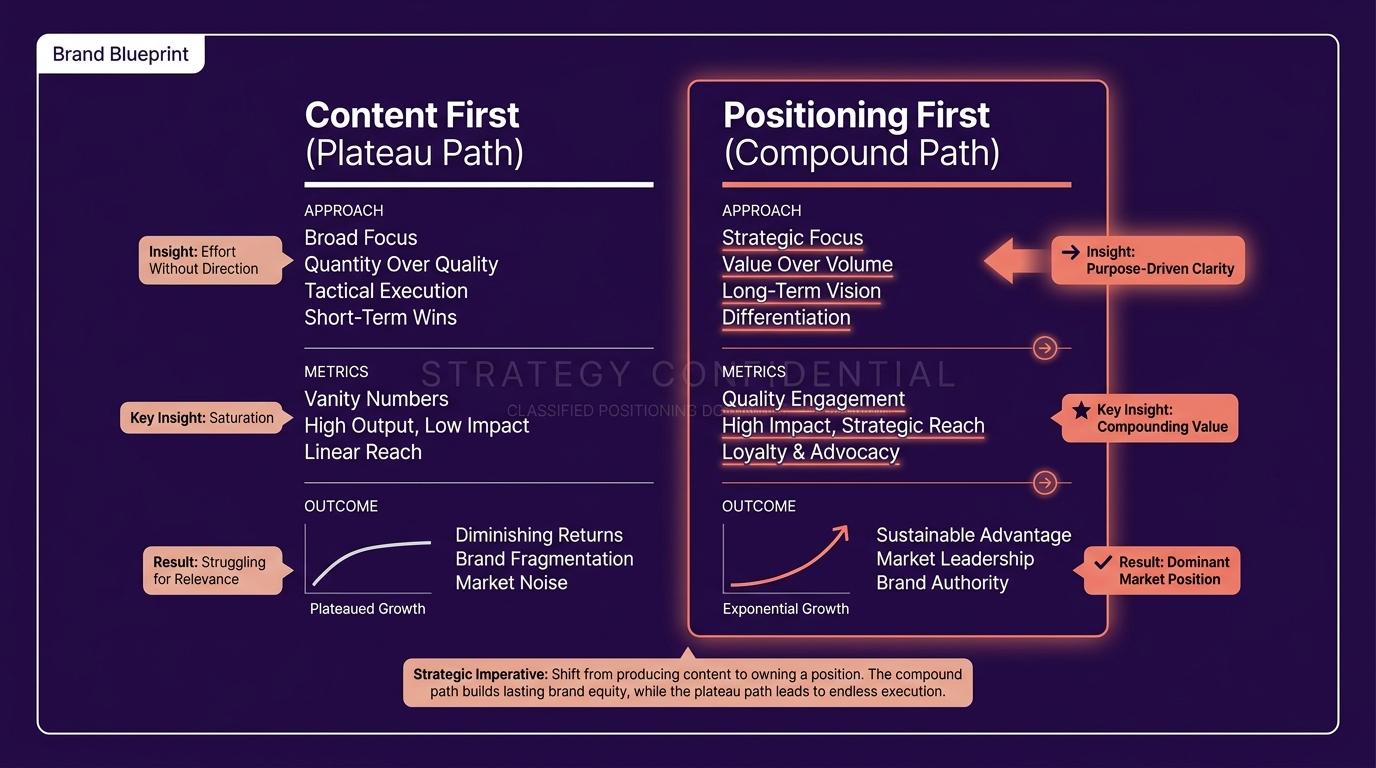
Most founders are producing more content than ever and building far less audience trust than they expected. That gap is the predictable result of building in the wrong order, and it closes the moment you change the sequence.
The structural reason is sequence. Brands that establish clear positioning before creating content build a compounding trust infrastructure. Brands that reverse the order produce content that gets consumed and forgotten. It is purely a sequence problem, and every founder reading this has the ability to solve it.
According to the Content Marketing Institute, 69% of the most successful B2B content marketers have a documented content strategy compared to just 16% of the least successful. The defining factor is what comes before the content strategy.
This post names the structural mechanism behind brand compounding. Fixing it requires the right foundation built in the right order, rather than additional budget or creative talent.
Why Most Content Strategies Miss the Structural Layer
Founders who struggle with content marketing are usually struggling with their foundation, not their creativity.
When a brand has no clear positioning, every piece of content starts from zero. There is no accumulated context for the audience to build on, no consistent signal helping them categorize the brand in their minds. The brand exists, but it does not mean anything specific yet. And an audience that cannot define what you mean to them cannot become the buyers, advocates, and community you are building toward.
This creates a plateau pattern where content is consumed, but nothing compounds.
The Meaning of Brand Positioning
Brand positioning is the deliberate act of defining where your brand lives in the mind of a specific audience: what problem you solve, for whom, and why you are the right answer over alternatives. More than a tagline, it is a structural decision about signal.
Without it, content has no home to point people toward. Think of positioning as the address all your content is trying to get people to remember. Without the address, you can send as many postcards as you like. Your audience just will not know where to find you.
Every market has a limited number of mental slots available in a buyer's mind. Positioning is the act of claiming one. Content without positioning relies on hoping the audience assigns you one on your behalf, which rarely happens. Claiming your slot with intention gives your content clear meaning.
The Failure of Content Without Positioning
Content marketing fails without positioning because each piece of content is solving a different problem for a different imagined reader with a different assumed context.
According to Nielsen, 59% of consumers prefer to buy from brands they already recognize and trust. That familiarity comes from repeated exposure to a consistent signal rather than a single encounter. Without positioning, there is no consistent signal to reinforce.
The result is an audience that reads your content, even values it, and still cannot articulate what makes you the right answer for their specific problem. You have created real value for them without building equity for yourself. That asymmetry is the structural flaw in content-first brand building, and it is entirely within your power to fix.
The Mechanics of Brand Compounding
Brand compounding is a structural phenomenon that mirrors financial compounding. Each interaction adds to the accumulated whole rather than starting fresh. And like financial compounding, the returns become extraordinary over time.
When positioning is established first, every piece of content contributes to a single, growing body of meaning in the audience's mind. The fifth post reinforces the fourth. The tenth deepens the trust established at the second. The audience is building a mental model of who you are and why you matter to them specifically.
According to McKinsey, strong brands outperform the stock market by 73% over time. The compounding effect is measurable at the business level.
The Process of Brand Trust Compounding
Brand trust compounds when audiences receive consistent, specific signals that confirm their initial impression across repeated exposures. The mechanism works like this: a clear positioning statement sets an expectation. Every piece of content either confirms or contradicts that expectation.
When content consistently confirms it, trust accumulates. Each confirmation is a deposit into the brand's trust account, with interest applied to prior deposits.
This is why some brands feel like recognized authorities after a few months while others feel forgettable after years of production. The differentiator is whether the content is compounding a specific signal or simply broadcasting at scale. LINK: brand trust framework
The Sequence Problem: Brand Positioning Before Content
Content cannot position your brand. Content can only reinforce positioning that already exists.
Founders often believe that creating enough content allows positioning to emerge organically, assuming the audience will figure out what the brand stands for. In reality, this rarely happens.
According to LinkedIn's B2B Institute, 95% of your target buyers are not in the market for your product at any given moment. The 5% who are ready to buy need a specific reason to choose you over alternatives. The 95% who are not yet ready need to build a mental model of your brand so that when they are ready, you are the obvious answer they return to.
Content without positioning cannot build that mental model. It can entertain. It can inform. But it cannot mean something specific in the audience's mind because there is no specific meaning defined at the structural level.
Establishing that meaning requires investment. It requires honest answers to hard questions about who you serve and why. That investment separates brands that compound from brands that plateau, paying returns that no posting schedule can replicate.
Brand Positioning vs. Content Strategy
Brand positioning defines the why and for whom: the structural identity of the brand. Content strategy defines the what, how often, and in what format. Positioning is the foundation. Content strategy is the architecture built on top of it.
Attempting to build content strategy without positioning is like designing floor plans before deciding what the building is for. You can produce beautiful, functional floor plans. They just will not serve the people who need to live and work there.
The sequence matters because positioning creates the interpretive frame through which all content gets received. A single well-positioned piece of content does more trust-building work than a hundred unmoored posts. The positioned piece lands in an existing mental folder, while the unmoored piece lands nowhere permanent. LINK: positioning statement guide
Two Brand Archetypes: Plateau vs. Compound
To make this structural argument concrete, consider two founders operating in the same market at the same stage.
Founder A: The Content-First Brand
Maya launches a project management tool for small teams. She starts a blog immediately, posting three times a week on productivity tips, team management, remote work, and software comparisons. The content is genuinely useful. Her traffic grows modestly. But after eight months, her audience does not know what makes her brand specifically different from the five other tools they follow.
They follow Maya for general productivity advice, not because they are being primed to buy her specific product. When she launches a promotion, conversion rates disappoint. Her audience has not been building toward anything. They have been consuming.
Founder B: The Positioning-First Brand
Daniel builds a similar tool. Before writing a single post, he spends three weeks answering three questions: Who specifically is this for? What specifically does it solve that alternatives do not? What should someone believe about this brand after three exposures?
His answers: his tool is built specifically for creative agencies managing client deliverables, not general small teams. Every piece of content he creates speaks directly to agency owners about the specific problem of client project chaos. He posts less frequently than Maya.
After eight months, Daniel's audience is smaller, but they buy at more than twice Maya's conversion rate. They have been building a mental model of Daniel's brand as the specific answer to their specific problem.
According to HubSpot, companies that document their positioning and strategy generate three times more leads than those operating without a defined framework. The defining difference between Maya and Daniel is sequence.
How Positioning Creates the Trust Infrastructure
Positioning before content does something specific to how audiences receive information: it creates a trust infrastructure that every subsequent piece of content loads into.
Think of it as a filing system in the reader's mind. When positioning is clear, the audience has a folder for your brand. Every piece of content gets filed correctly, reinforcing who you are and why you matter to them. When positioning is absent, the audience has no folder. Content lands somewhere, but it does not accumulate into anything retrievable.
According to Edelman's Trust Barometer, 81% of consumers say they need to trust a brand before making a purchase decision. That trust is built through repeated, consistent signals that confirm a clear brand identity over time.
The Speed of Brand Growth
Faster-growing brands focus on producing more positioned content. Each piece does double work by delivering value to the reader while reinforcing a specific brand identity in the market.
This is the structural advantage that compounds. A brand with clear positioning turns every content interaction into a trust deposit. A brand without positioning turns every content interaction into a one-time transaction with no cumulative effect on brand equity.
The speed differential becomes dramatic over twelve months. A positioned brand has built a compounding body of trust with a gravitational center that pulls the right buyers back. An unpositioned brand has a library of posts with no center of gravity.
According to the Content Marketing Institute, it takes an average of seven to eight touchpoints before a prospect trusts a brand enough to engage seriously. For positioned brands, those touchpoints are cumulative and build on each other. For unpositioned brands, each touchpoint frequently starts the process from scratch. LINK: content touchpoint strategy
Brand Positioning Before Content: What to Do Before Your Next Post
If you recognize your brand in the plateau archetype, you need to establish positioning before creating more content.
Before writing another post, answering another question, or planning another campaign, three structural questions need documented answers. Answering them well takes real thought. That upfront investment is what makes everything that follows compound rather than evaporate.
1. Who, specifically, are you for?
Define a specific person with a specific problem in a specific context. The tighter this answer, the more impact every piece of content delivers.
2. What, specifically, do you solve, and why does that gap exist in alternative solutions?
Provide a clear articulation of the specific gap your brand fills and why established alternatives leave it open. The answer should be narrow enough to be defensible.
3. What should someone believe about your brand after three exposures?
This is your positioning signal. If you cannot answer this, your audience cannot answer it either, regardless of how much content you produce. The signal must be simple enough to transmit and specific enough to be memorable.
Once these three questions have documented answers, content strategy becomes structurally straightforward. Every piece of content either reinforces answer one, two, or three. Decisions about topics, formats, and channels become faster because there is a positioning filter to run them through.
According to Forrester Research, brands that lead with a documented positioning strategy see 20 to 25% higher customer retention rates over 24 months. The compounding begins with the foundation, rather than content volume. LINK: brand positioning worksheet
The Structural Advantage That Compounds Always
The difference between brands that compound audience trust and brands that plateau is purely sequence.
Positioning-before-content is the structural mechanism that transforms content from a series of individual transactions into a compounding trust infrastructure. Every post, email, video, and social update becomes a deposit into a growing account of brand meaning in your audience's mind.
Successful brands produce oriented content that points to a clear, specific position in the market and reinforces it with every interaction. That future is available to any founder willing to build the foundation before building the house.
According to Nielsen, brands that maintain consistent positioning across all touchpoints see an average revenue increase of 23% compared to those with inconsistent or undefined messaging. Consistency is only possible when positioning exists structurally before content begins.
The founders building fast, trusted, compounding brands simply built the foundation before they built the house.
Start With Sequence
This pattern plays out across every market, industry, and budget level because it relies on structure.
If your content is not compounding, the solution is establishing clearer positioning first.
Here are three concrete steps to take before your next content planning session:
-
Document your positioning in one page. Answer the three structural questions above in writing before anything else. A single clear page is more valuable than a 30-post content calendar built on an unclear foundation.
-
Audit your last ten pieces of content against that positioning statement. Ask of each one: does this reinforce a specific, consistent signal, or is it broadcasting generally to no one in particular? The audit will reveal the pattern faster than any analytics dashboard.
-
Choose one positioning signal to commit to for 90 days. Consistency over that window is what initiates the compounding process. Breadth of topics is the enemy of compounding at the early stage.
The structural advantage requires discipline to execute, specifically the discipline to do things in the right order. [LINK: 90-day positioning sprint] LINK: content audit template
For founders wondering why trust is not building as expected, the answer has been structural all along. Fix the sequence, and the compounding follows. This mechanism is inevitable for founders who build in the right order.
Snappin Team
Strategy-first marketing insights from the team building Snappin — the AI Marketing Copilot that combines strategy, content creation, and scheduling in one platform.
Try Snappin freeContinue Reading
Strategy-First Positioning: A Framework for Founders
If you've invested months in an agency relationship and still can't articulate what makes your brand genuinely different, that is a positioning problem. That distinction changes everything about how you solve it. The strategy-first positioning framework gives founders a structured path to build real
Brand Strategy Retainer: The Agency Deliverables You're Actually Paying For
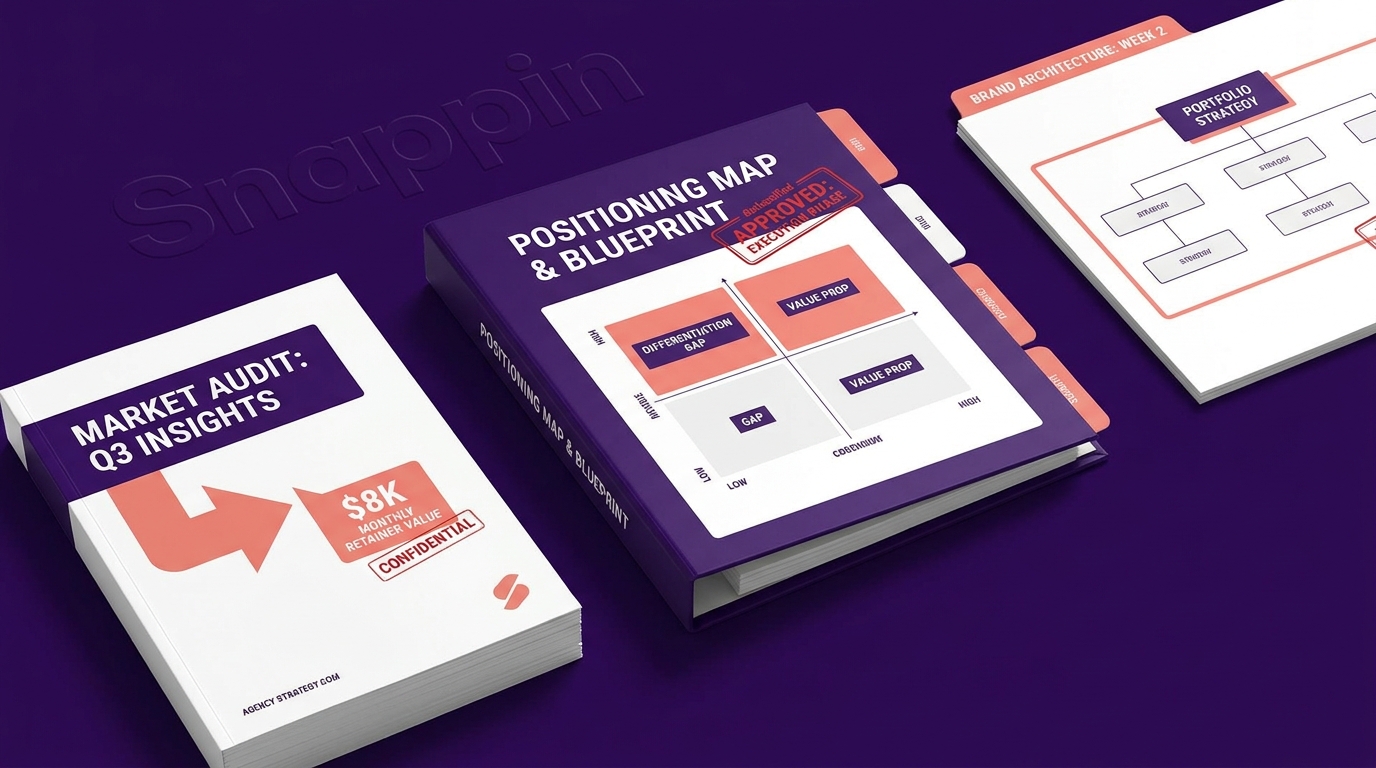
A brand strategy retainer at $8k, $15k/month is built on five core deliverables: market research methodology, positioning framework, brand architecture, competitive analysis, and expression system. These are specific frameworks agencies have spent years productizing, rather than vague consulting hou
Brand Design Elements: The Silent Positioning Signal
Every founder spends weeks crafting the perfect brand message. Then they unknowingly contradict it with their color palette. Brand design elements (color psychology, visual hierarchy, and typography) function as a non-verbal language that either reinforces your positioning or silently argues against