Competitive Intelligence for Founders: The Mechanism

The competitive intelligence you need to outposition your market already exists. It lives inside your operational experience, your sales conversations, and your intuitive understanding of why customers choose you over every available alternative. Competitive intelligence for founders doesn't require research firms, marketing degrees, or expensive agency retainers. It requires the right questions, asked in the right sequence. When that structure exists, your answers surface positioning gaps, competitor weaknesses, and market opportunities that strategy teams spend weeks building from scratch.
That's the paradox most founders never resolve.
You already know why customers choose you over alternatives. You've lived inside the competitive market long enough to recognize its patterns: where it bends, where competitors are vulnerable, where buyers are underserved. The bottleneck has never been access to intelligence. It has been extraction: translating tacit founder knowledge into structured, strategic outputs that actually direct your marketing.
This post explains precisely how that extraction works, and what becomes possible when it does.
The Intelligence Hiding Inside Every Founder
According to a 2023 survey by Crayon LINK: competitive intelligence statistics, 84% of businesses report that competitive intelligence positively impacts revenue, yet most early-stage founders never build a systematic process to generate it.
The missing element is architecture.
Most founders have accumulated years of first-hand competitive data through lived experience: sales calls where prospects revealed a competitor's critical weakness, support tickets that exposed what customers couldn't find anywhere else, pricing conversations that laid bare what buyers actually valued when forced to choose. This is raw, unfiltered market intelligence of the highest order. Almost none of it ever gets structured.
It rarely translates into a positioning map, differentiated messaging, or a foundation that makes your marketing work.
The main bottleneck in founder-led companies is the absence of a mechanism to transform awareness into usable intelligence. That distinction matters, because infrastructure is a solvable problem, and knowledge scarcity isn't the actual constraint.
What Competitive Intelligence for Founders Actually Produces
When a strategy agency conducts competitive research for a client, they rarely discover facts the founder doesn't already know. They do something more precise: they structure what's known into frameworks that reveal implications. The structure (not the raw data) is the actual deliverable.
According to McKinsey LINK: McKinsey strategic positioning research, companies with clearly defined positioning strategies are twice as likely to outperform competitors on revenue growth over a five-year period. Organization provides the real advantage.
Agency-grade competitive research produces three core outputs:
- Competitive positioning maps: where you sit relative to alternatives on the criteria buyers actually use to decide
- Differentiation architecture: what makes you defensible, articulated with enough specificity that buyers can repeat it
- Validated messaging: language drawn from real market signals rather than internal assumptions about what should sound persuasive
Founders already have access to the underlying inputs for these outputs. The challenge is organizing them into something strategically useful instead of leaving them locked in operational memory, directing nothing.
Why Is Competitive Intelligence Difficult for Founders?
Competitive intelligence is difficult for founders because the knowledge is unstructured and context-dependent; it lives in memory and lived experience, not in documents or frameworks. Without a structured process to extract and organize it, even founders with a decade of market experience struggle to translate what they know into clear positioning strategy. While knowledge exists in abundance, the mechanism to surface it typically does not.
This is the first critical insight the mechanism depends on: it addresses an extraction deficit rather than a knowledge deficit.
Can Founders Do Competitive Intelligence Without a Marketing Team?
Yes, founders can conduct rigorous competitive intelligence without a marketing team, provided they use a structured methodology rather than relying on ad hoc observation and intuition. The key is systematic extraction: asking the right questions in a sequence designed to surface positioning insights rather than simply gather information. When the structure is right, marketing expertise becomes optional. The methodology carries the analytical weight.
This shifts the bottleneck from capability to infrastructure, and infrastructure is a solvable problem.
Structured Questioning: The Core Extraction Mechanism
Structured questioning has long been the foundation of ethnographic research, clinical interviews, and consulting frameworks like Jobs-to-Be-Done [LINK: Jobs to Be Done framework]. The specific insight that makes it powerful here: founder answers to well-designed questions reveal competitive intelligence that no external researcher could surface faster.
This works because of three properties that expert knowledge reliably exhibits under structured conditions.
Specificity under constraint. When questions are narrow and sequenced, answers become dramatically more precise. A founder asked "why do customers choose you?" produces a general answer shaped by habit. A founder asked "describe the moment in a sales conversation when a prospect's hesitation disappears" produces positioning intelligence.
Comparative framing. Questions that force comparison (like "what do competitors offer that you deliberately don't?") surface competitive differentiators that founders rarely articulate unprompted. The act of comparing creates clarity that reflection alone doesn't produce.
Contradiction as signal. When a founder's answers contain internal contradictions, like claiming a differentiated product while describing generic buyer motivations, those contradictions are intelligence. They reveal positioning gaps that competitors can and do exploit.
According to Nielsen Norman Group [LINK: UX research methodology], structured interviews consistently produce higher-quality strategic insights than unstructured conversations, regardless of the interviewer's domain expertise. The structure performs the analytical work. The subject provides the raw material.
What Questions Reveal Competitive Positioning?
Questions that reveal competitive positioning focus on three domains: buyer beliefs (what a customer must accept as true to be willing to pay your price), switching moments (the specific circumstances when a prospect decides their current solution is no longer sufficient), and competitive respect (what alternatives do well that you genuinely don't). These three lenses, applied systematically to founder answers, produce a positioning framework that reflects actual market dynamics rather than internal assumptions about what should be true.
None of these questions require marketing expertise to answer. They require honest engagement with operational experience.
The Extraction Process: From Answers to Strategic Outputs
Consider a founder of a B2B software company working through a structured question set. These questions focus on operational truth rather than marketing copy:
- "What does a customer have to believe to be willing to pay your price?"
- "What's the first thing a prospect says when they realize they need what you sell?"
- "Name one competitor you genuinely respect and explain specifically why."
- "Describe a moment a customer tried to leave and didn't. What changed their mind?"
Instead of mission statements or elevator pitches, they target moments, observations, and comparisons: the texture of lived competitive experience, the only kind that carries real strategic weight.
According to CB Insights [LINK: startup failure reasons], 35% of startups fail due to "no market need," a category that almost always reflects positioning failure rather than product failure. The product solves a real problem. The founders simply never found language that connected their solution to how buyers were describing that problem to themselves.
Structured questioning closes that gap by working backward from operational experience to strategic language, rather than forward from strategic aspiration to market reality.
These answers are processed through an analytical framework that maps them into competitive positioning outputs. The founder provides the raw material. The methodology provides the expertise. The distinction between those two roles is what makes no prior marketing knowledge a genuine requirement, not a polite lowering of expectations.
Why Most Founders Miss Their Own Competitive Intelligence
There's a deeper cognitive dynamic at work here, and understanding it clarifies why the mechanism matters.
Founders are inside their businesses. That proximity is their greatest asset when answering structured questions, and their greatest obstacle to doing so unprompted. When you're close to something, the things that make it distinctive become invisible. They feel obvious, unremarkable, and go unsaid.
This is the curse of knowledge, a well-documented cognitive bias [LINK: curse of knowledge cognitive bias] in which deep expertise makes it harder to recall what it felt like not to possess that knowledge. Experts stop explaining the things they find obvious. But those obvious things are almost always the most powerful competitive differentiators, precisely because competitors haven't articulated them either.
According to Gartner [LINK: B2B buying research], B2B buyers spend only 17% of their purchase journey in direct conversation with vendors. The remaining 83% is independent research. That means your positioning must be legible without explanation; it must communicate clearly without you present to clarify. Most founders' positioning lacks legibility not because it lacks strength, but because it was never extracted, structured, and made explicit.
Structured questioning breaks the curse of knowledge by creating external pressure to articulate what feels obvious. The questions force specificity over generic answers. In that forced specificity, the real competitive intelligence emerges, ready to direct your marketing rather than remain locked in operational memory.
How Do You Turn Founder Answers Into a Positioning Strategy?
You turn founder answers into positioning strategy by running them through an analytical framework that identifies three elements in each response: the buyer belief the answer implies, the competitive alternative the answer implicitly references, and the claim that would most credibly distinguish you given both. This process relies on classification and synthesis rather than creative copywriting, utilizing the kind of structured analysis that a methodology can execute systematically once the answers exist. The framework handles the analysis, not the founder.
The result is a positioning map drawn directly from the founder's knowledge.
The Output: Agency-Grade Artifacts Without Agency Cost
The output of a well-designed structured questioning process surprises most founders, not because of its complexity, but because of how precisely it reflects what they already know about their market.
The typical deliverables include:
Competitive positioning analysis. A map of where you sit relative to alternatives, not based on a feature comparison spreadsheet, but based on the buyer beliefs and switching triggers your answers revealed. This is the difference between knowing your competitors' pricing and understanding why buyers choose them.
Differentiation statements. Language that articulates why you win, grounded in the specific mechanisms your answers surfaced. Not "we're more innovative" or "we care more about customers" (claims any competitor could make) but actual cause-and-effect explanations of your competitive advantage.
Validated messaging architecture. A hierarchy of messages ranked by the strategic weight of the positioning insights supporting them: what to lead with, what to save for later in the buyer journey, and what to stop saying entirely because it doesn't connect to how buyers actually decide.
Market gap identification. Contradictions and absences in your answers that reveal where competitors are systematically underserving buyers you could capture, if your positioning makes that gap legible to them.
According to Harvard Business Review [LINK: competitive positioning strategy], 85% of executives struggle to clearly articulate how their company differs from competitors. This represents a failure of infrastructure rather than intelligence. These executives understand their businesses deeply. They simply haven't had access to a mechanism that translates operational knowledge into strategic language.
According to Forrester Research [LINK: marketing strategy ROI], companies that invest in strategic positioning foundations before scaling marketing spend see 3x better ROI on content and advertising investment. The foundation multiplies everything that comes after it.
Getting the extraction process right serves as the most impactful investment a founder can make before scaling anything else, and it compounds.
The Bigger Vision: Strategic Marketing for Every Founder
For decades, agency-grade competitive intelligence and validated positioning strategy were accessible only to companies that could afford strategy retainers, brand consultants, or marketing teams with research training. Smaller companies, and the founders building them, made positioning decisions based on intuition, imitation, or inertia. They guessed at differentiation. They borrowed language from competitors. They shipped marketing that never quite connected with how buyers were actually thinking.
This stems from an infrastructure problem rather than a lack of talent, and infrastructure problems have structural solutions.
When the right questions are built into the infrastructure, when the analytical framework exists before the founder sits down to answer, the expertise gap closes. A founder with no marketing background, answering honest questions about their operational experience, can produce competitive intelligence that rivals what took a strategy agency three weeks to develop.
According to the 2023 State of Competitive Intelligence report [LINK: competitive intelligence industry report], only 29% of companies under 50 employees have a formal competitive intelligence process. The other 71% are making positioning decisions without it, not because they don't need it, but because the infrastructure to produce it hasn't been accessible to them.
This represents a structural change in who gets access to serious strategic marketing capability in the first place, expanding what becomes possible for the founders who move first.
The Intelligence Was Always There
Competitive intelligence for founders focuses on structuring what you already know into outputs that strategy teams would recognize and use immediately, rather than gathering more market data.
The mechanism is precise: structured questioning creates conditions where founder knowledge, specific, comparative, and contradiction-rich, gets extracted, classified, and synthesized into positioning architecture that reflects actual market dynamics. It requires no marketing expertise, research team, or six-week agency engagement.
The intelligence was always there. It needed the right questions.
Three things worth doing from here:
- Audit your current positioning language: ask whether a buyer who has never spoken to you could explain, in their own words, why you're different. If the answer is no, your competitive intelligence hasn't been extracted yet. [LINK: positioning audit guide]
- Notice what you find obvious: the things you never bother explaining about your business are almost always your most powerful differentiators. The curse of knowledge hides your best positioning in plain sight. Start writing down what you assume everyone already knows.
- Examine the mechanism directly: if you're building a company and you haven't yet translated your founder knowledge into validated competitive positioning, the next step is the extraction process itself rather than more content or advertising.
The foundation changes everything that comes after it.
Snappin Team
Strategy-first marketing insights from the team building Snappin — the AI Marketing Copilot that combines strategy, content creation, and scheduling in one platform.
Try Snappin freeContinue Reading
Strategy-First Positioning: A Framework for Founders
If you've invested months in an agency relationship and still can't articulate what makes your brand genuinely different, that is a positioning problem. That distinction changes everything about how you solve it. The strategy-first positioning framework gives founders a structured path to build real

The Mechanics of Reach: A Strategic Guide to Social Media Algorithms
If you want consistent reach, stop looking for "viral hacks." Building a real brand on social media isn't about winning a lottery; it’s about understanding how the platforms actually work.
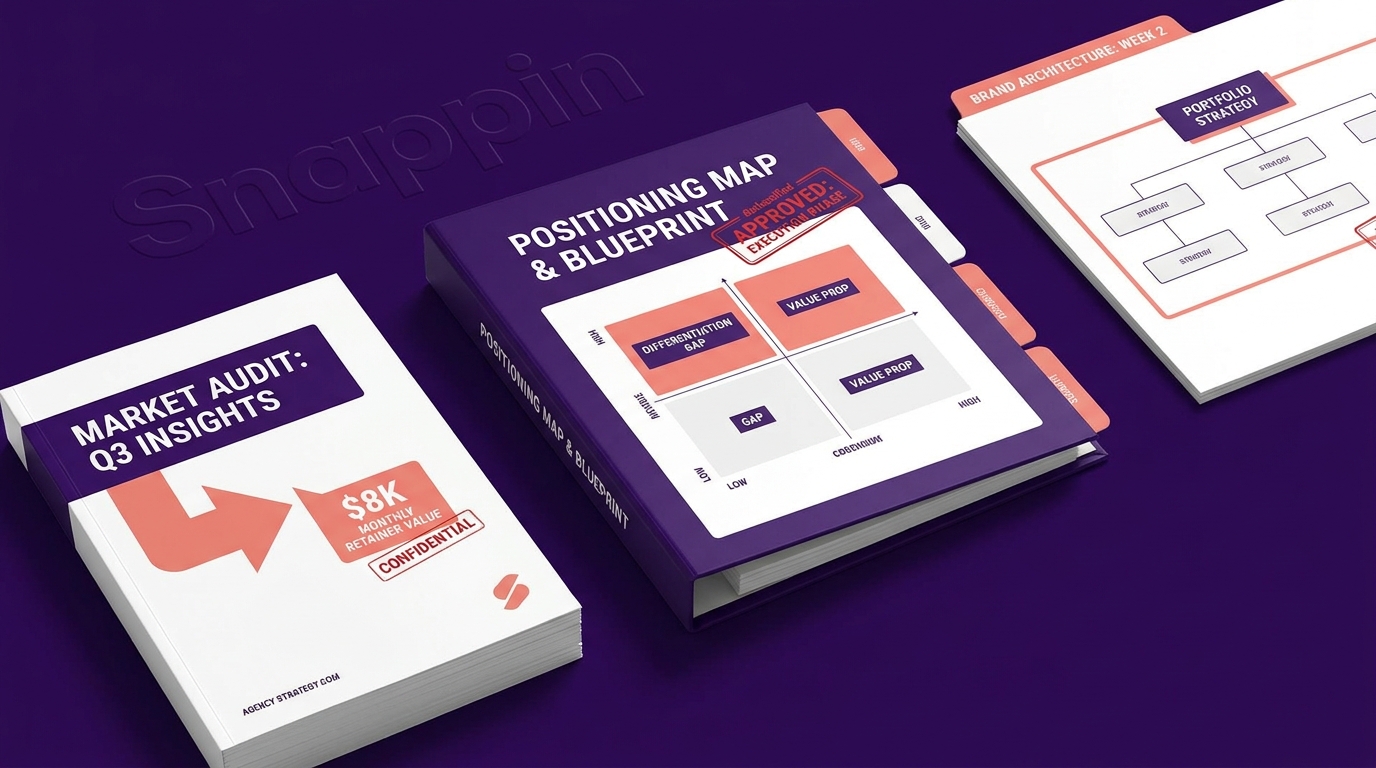
Brand Strategy Retainer: The Agency Deliverables You're Actually Paying For
A brand strategy retainer at $8k, $15k/month is built on five core deliverables: market research methodology, positioning framework, brand architecture, competitive analysis, and expression system. These are specific frameworks agencies have spent years productizing, rather than vague consulting hou