Strategic Content Sequencing: What 42 Days Builds
TL;DR: When every post advances a single brand narrative across 42 days, something compounding takes hold, brand equity that reactive posting simply cannot replicate. The difference between a brand that builds and a brand that spins is architecture.
Most content calendars are built backwards. The first question becomes how many posts per week? instead of what story are we telling and where does it lead?
The result is a feed that looks active but functions as noise: posts that generate individual likes but accumulate no meaningful trust or momentum toward a measurable outcome.
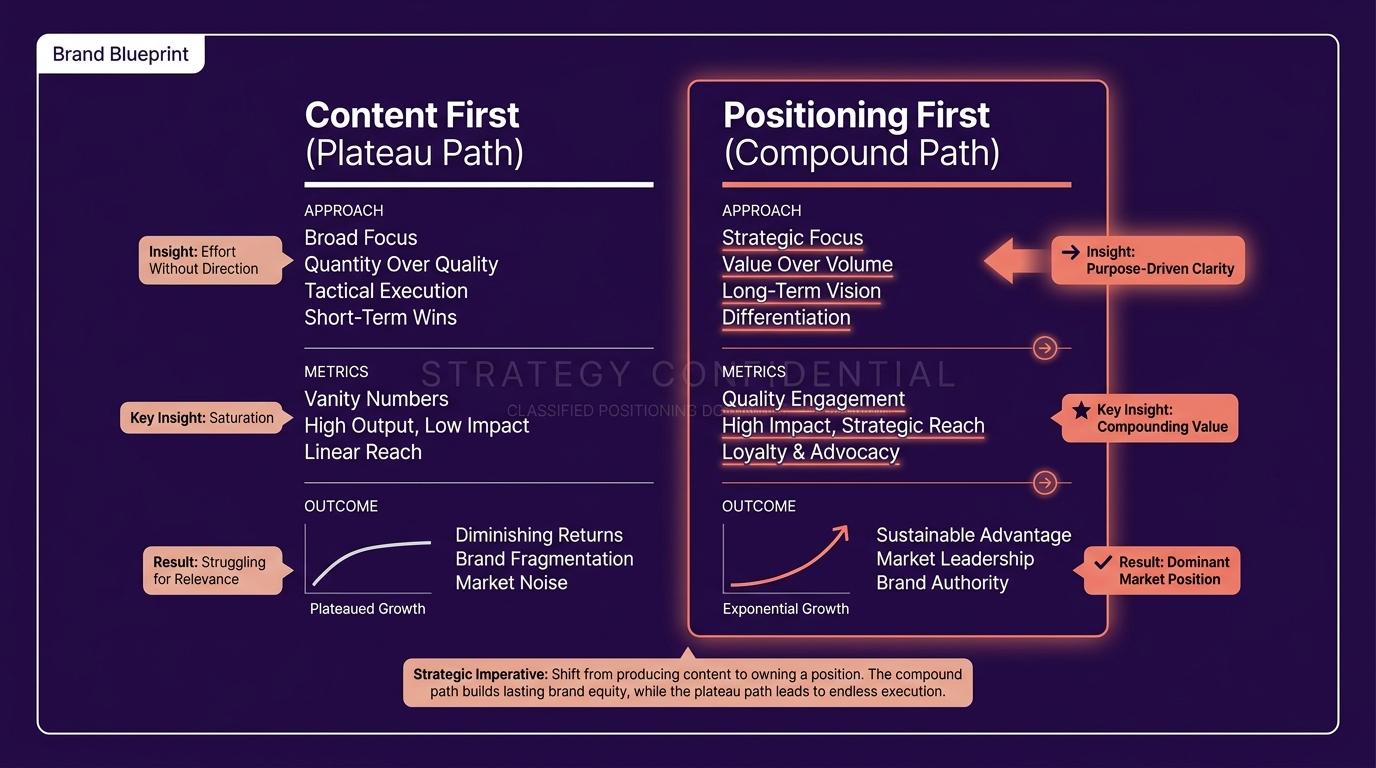
This is the comparison that matters: 42 days of strategically sequenced content versus 42 days of reactive, volume-based posting. Both use the same platforms. Both require roughly the same time investment. Only one builds something that lasts.
According to [Content Marketing Institute], brands with documented content strategies are 3x more likely to report success than those without, yet fewer than 40% of B2C marketers have a documented strategy at all.
What follows is an exact breakdown of what 42 days of strategic content produces, phase by phase, week by week, and why reactive posting, regardless of how consistently it's executed, cannot manufacture the same outcome.
What Strategic Content Sequencing Actually Means
Strategic content sequencing focuses on designing content so that each piece builds upon the last, moving your audience through a defined narrative arc from first impression to committed relationship.
Think of it the way a screenwriter approaches a six-episode series. Every scene serves the arc. Nothing is filler. Tension builds. Payoffs land. Viewers feel the momentum carrying them forward.
Brand content operates the same way. When a founder posts on Monday, the Tuesday post should deepen what Monday established. The Friday post should crystallize what the week built. Over six weeks, the audience hasn't just consumed content; they've traveled through a narrative with a beginning, a turning point, and a resolution that makes action feel natural.
Why Most Content Fails to Build Brand Equity
Most content fails to build brand equity because it's created in isolation. A post about industry trends this week, a motivational quote next Tuesday, a product feature on Friday. Each might perform adequately as a standalone piece, but together they form no cumulative argument.
According to [Nielsen], it takes an average of 7 meaningful brand touchpoints before a consumer moves toward a purchasing decision. Reactive posting delivers 7 random impressions. Strategic sequencing delivers 7 coordinated steps in a single direction.
The distinction is architectural. One is a pile of bricks. The other is a building.
What "Advancing a Single Brand Narrative" Really Looks Like
A single brand narrative ensures every post contributes to one overarching truth you want your audience to carry about your brand.
Consider this example: Strategic marketing has always been available to well-funded brands, and it's now accessible to every founder. That is a narrative. Every post either sets it up, deepens it, proves it, or resolves it.
The narrative functions as a through-line. Audiences may miss individual posts. They will not miss the cumulative impression of a brand that consistently understands them and always seems to be building toward something meaningful.
The 42-Day Strategic Content Arc: Phase by Phase
Here is what 42 days of strategically sequenced content looks like when it has been thoughtfully designed. The arc divides into six phases. Each phase carries a named objective, a content posture, and a measurable narrative milestone.
Week 1: The Foundation Phase (Days 1, 7)
Objective: Establish credibility and define the problem you solve with precision.
No selling. No features. Pure value delivery that demonstrates you understand the audience's world better than they can yet articulate for themselves. Posts in this phase are diagnostic: they name frustrations, surface patterns, and reflect the audience's own experience back with enough specificity that they feel genuinely seen.
Narrative milestone: The audience recognizes this brand as one that truly understands their problem.
According to [Edelman's Trust Barometer], 81% of consumers say trust is a deciding factor in purchasing decisions, and trust is built through demonstrated understanding long before it's ever built through product claims.
Week 2: The Problem Amplification Phase (Days 8, 14)
Objective: Deepen the problem diagnosis and introduce the real cost of inaction.
This is where reactive-posting brands lose the narrative. They move to solution too quickly, before the audience has fully internalized why their current approach is failing them. Strategic sequencing holds here. It expands the scope of the problem, revealing how what appears to be a tactical issue is actually systemic.
Narrative milestone: The audience understands that their current approach isn't just suboptimal; it actively prevents the outcome they want.
Week 3: The Reframe Phase (Days 15, 21)
Objective: Introduce the strategic lens that changes how the audience sees the problem entirely.
This is the intellectual turning point of the arc. Posts in this phase offer a new way of seeing. By Day 21, the audience isn't simply aware of a problem. They're operating with a new mental model that makes your solution the only logical response.
According to [Harvard Business Review], companies that lead with insight, genuinely reframing how buyers think about their situation, outperform product-feature-led approaches by 53% in complex buying scenarios.
Narrative milestone: The audience has adopted a new frame. They now see what was invisible before.
Results Produced by Day 28
By Day 28, strategically sequenced content produces something no single viral post can manufacture: cumulative trust. The audience has moved through a complete diagnostic and reframe experience. They've been seen, educated, and equipped with a new lens. According to [Demand Gen Report], nurtured leads make 47% larger purchases than non-nurtured leads, because the journey heavily shapes the final decision.
Week 4: The Authority Demonstration Phase (Days 22, 28)
Objective: Prove you can deliver the transformation you've described.
This is where case studies, frameworks, and specific evidence enter the sequence as proof points for an audience now primed to receive them.
The same case study posted in Week 1 would have landed flat. Posted in Week 4, after three weeks of diagnostic and reframe content, it lands as confirmation of everything the audience has been building toward.
Narrative milestone: The audience believes you can solve what you've diagnosed.
Week 5: The Social Proof Phase (Days 29, 35)
Objective: Amplify the narrative through external validation and community signal.
By Week 5, the audience has heard your argument. Now they need to hear it reflected by others. Testimonials, data points, community responses, and peer examples enter the sequence here as evidence that the transformation you've described is real and repeatable.
Narrative milestone: The audience believes this outcome is achievable for them specifically rather than just for case study subjects.
Week 6: The Commitment Phase (Days 36, 42)
Objective: Convert understanding and trust into action.
This is the only phase where explicit calls to action belong. By Day 36, you haven't rushed to this moment. You've earned it. The audience is invited to take a next step they're already internally motivated to take.
Posts in this phase resolve the narrative tension established in Week 1. They feel like an authentic arrival.
Narrative milestone: The audience takes action from a position of informed conviction, not impulse.
What the Same 42 Days Looks Like as Reactive Posting
Now compare that arc to 42 days of reactive, volume-based posting, the default most brands fall into when content calendars are built around platform best-practice articles rather than strategic intent.
The content calendar gets filled. Posts go out consistently. Engagement numbers look reasonable week to week. However, several critical elements are missing:
- No cumulative argument is built. Each post is standalone. The audience that sees Monday's post and misses Tuesday's doesn't miss anything narrative because there is no narrative.
- No trust is established. Individual posts can generate likes. They cannot, on their own, generate the sequence of impressions that moves someone from awareness to conviction.
- The brand remains interchangeable. Without a distinctive narrative, even well-executed content fails to differentiate. According to [Sprout Social], 45% of consumers will unfollow a brand whose content feels irrelevant or disconnected, and reactive posting is disconnected by definition.
According to [Content Marketing Institute], brands that prioritize content strategy see 6x higher conversion rates than those that don't. Volume without strategy is expensive noise.
The Illusion of Reactive Content Productivity
Reactive content creates the sensation of progress because it generates activity. Posts go out. Metrics accumulate. The calendar fills. However, activity differs entirely from momentum.
A car spinning its wheels creates a lot of motion without actually moving forward.
The difference is direction. Strategic sequencing assigns every piece of content a vector, a specific role in advancing the audience's understanding and relationship with the brand. Without that vector, effort compounds into nothing.
Strategic Content Sequencing as a Brand Asset
Strategic content is a brand asset.
Reactive posts depreciate the moment they're published. A trend-chasing post from six weeks ago carries no residual value. It doesn't compound. It doesn't inform the next piece. It was consumed and forgotten.
A strategically sequenced content arc creates something fundamentally different: a body of work, one that tells a coherent story, builds a navigable archive, and continues converting new audience members even while new content is being produced.
Building Long-Term Brand Equity Through Strategic Content
Strategic content builds long-term brand equity by creating a consistent narrative identity, a recognizable point of view that audiences carry between posts. According to [McKinsey], brands with strong narrative consistency generate 20% higher customer lifetime value than those without. The brand becomes associated with a specific lens, a specific transformation, a specific promise, and that association compounds over time like interest on principal.
Strategic Content Sequencing for All Brands
Strategic content sequencing has historically belonged to well-resourced brands with agency partnerships and dedicated strategy teams. A 42-day arc with defined phases, measurable milestones, and coherent narrative logic used to require significant infrastructure that most founder-led brands simply couldn't access.
That shift changes everything.
The strategic methodology that once lived inside agency strategy decks is now available as a structured system. Which means the compounding advantage of strategic sequencing is now a function of decision rather than budget size.
The Measurable Difference: Narrative Milestones vs. Vanity Metrics
Strategic sequencing outperforms reactive posting on the metrics that matter because it optimizes for narrative milestones over engagement rates.
Narrative milestones are internal audience states:
- "This brand understands my situation." (Week 1)
- "My current approach is costing me more than I realized." (Week 2)
- "I see this problem differently now." (Week 3)
- "I believe they can deliver the transformation they're describing." (Week 4)
- "Others like me have achieved this result." (Week 5)
- "I'm ready to take the next step." (Week 6)
These milestones are invisible in your analytics dashboard. But they are the actual mechanism by which content converts audiences into buyers, advocates, and long-term brand relationships.
According to [Salesforce's State of Marketing], 84% of customers say the experience a company provides is as important as its products or services. The 42-day arc is fundamentally an experience design challenge.
Measuring Content Narrative Success
You measure the success of a content narrative through leading indicators that signal audience progression rather than passive consumption. Content saves and shares indicate resonance. Reply quality indicates depth of engagement. Email list growth during the arc indicates active opt-in trust. Conversion rates at the close of the sequence indicate successful narrative completion.
Vanity metrics (reach and follower count) tell you about distribution, while narrative metrics tell you about persuasion. The latter directly fills a pipeline.
Why Every Founder Deserves a Strategy, Not Just a Schedule
There is a persistent and damaging assumption in content marketing conversations: that strategy is a premium tier, something you graduate to once you've mastered the basics.
Strategy is the foundational unit of brand-building. Everything else (the posts, the formats, the publishing cadence) is execution that either serves a strategy or doesn't.
According to [HubSpot's State of Marketing], companies with documented content strategies are 4x more likely to report strong ROI than those operating without one. The strategy itself serves as the primary driver.
Founders typically have the will to be strategic, but lack access to the infrastructure (the frameworks, the sequencing logic, the narrative structure) that transforms good content into compounding brand equity.
The 42-day arc described here serves as the exact architecture that has consistently produced results for brands that could afford to commission it. What's shifting now is access, and access changes everything.
Start Building the Arc, Not Just the Calendar
The dividing line between a brand that compounds and a brand that churns content is the presence or absence of a strategic narrative designed to advance toward a defined outcome over a defined arc.
Three concrete next steps you can take today:
-
Define your single brand narrative. What is the one overarching truth you want your audience to hold about your brand by Day 42? Write it in one sentence before you write another post. That sentence becomes your editorial compass.
-
Map your audience's internal journey. For each of the six phases, write one sentence describing the internal state you want your audience to be in by the end of that week. This becomes the filter through which every post gets approved or rejected.
-
Audit your last 42 posts. Do they tell a story with a beginning, middle, and end? Do they build on each other? If not, you now understand the precise difference between what you've been producing and what strategic content sequencing actually produces.
The content calendar must be architected.
The difference between 42 days that builds something durable and 42 days that produces forgettable noise is design. And strategic content sequencing, as both a discipline and a system, is no longer reserved for brands with agency retainers.
It is a decision available to every founder who is ready to stop filling a calendar and start building a brand.
Snappin Team
Strategy-first marketing insights from the team building Snappin — the AI Marketing Copilot that combines strategy, content creation, and scheduling in one platform.
Try Snappin freeContinue Reading
Strategy-First Positioning: A Framework for Founders
If you've invested months in an agency relationship and still can't articulate what makes your brand genuinely different, that is a positioning problem. That distinction changes everything about how you solve it. The strategy-first positioning framework gives founders a structured path to build real

The Mechanics of Reach: A Strategic Guide to Social Media Algorithms
If you want consistent reach, stop looking for "viral hacks." Building a real brand on social media isn't about winning a lottery; it’s about understanding how the platforms actually work.
Brand Positioning Before Content: Why Some Brands Compound
Most founders are producing more content than ever and building far less audience trust than they expected. That gap is the predictable result of building in the wrong order, and it closes the moment you change the sequence.