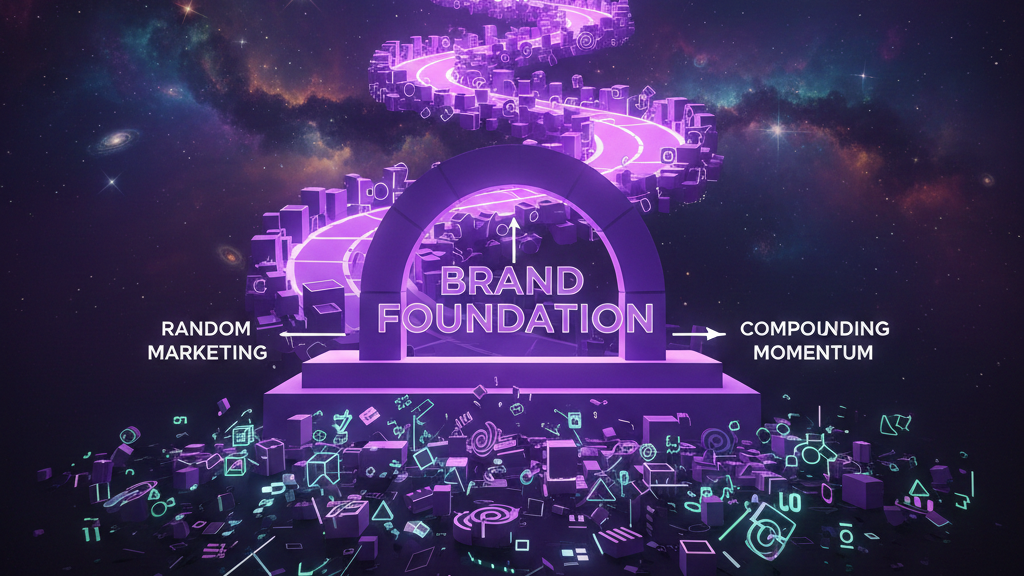
How Brand Foundation Transforms Random Marketing Into Compounding Momentum
You're posting on social media. Running ads. Sending emails. Attending events. Each activity feels productive in isolation, but six months later, you look back and see... what, exactly? More followers who don't convert. Campaign results that don't repeat. Traction that evaporates the moment you stop pushing.
This isn't a work ethic problem. It's a brand foundation problem. Without clear positioning, competitor differentiation, and strategic messaging anchors, every marketing activity starts from zero. You're not building momentum—you're running on a treadmill.
Here's the transformation most founders miss: a proper brand foundation doesn't just improve individual campaigns. It converts random marketing activities into a compounding system where each effort amplifies the last. This article breaks down exactly how that mechanism works and why it matters for your growth trajectory.
The Random Activity Trap: Why Marketing Feels Like Starting Over
Most early-stage marketing operates in what we call the Random Activity Trap. You execute individual tactics—a webinar here, a content series there, a partnership conversation—but each exists in isolation. No consistent message threads through them. No strategic positioning guides the execution. No competitor research informs your differentiation.
The result? Every new campaign requires the same exhausting work: figuring out what to say, how to say it differently than last time, why someone should choose you. You're essentially reintroducing your brand with each touchpoint because nothing builds on what came before.
The math is brutal: If each marketing activity generates a 1x return in isolation, ten activities give you 10x total. Linear growth. Meanwhile, competitors with strategic foundation see their activities compound: 1x becomes 1.2x becomes 1.5x as brand recognition, message consistency, and positioning clarity create momentum. Same effort, exponentially different outcomes.
This isn't theoretical. We've seen founders spend $50,000 on advertising over twelve months with nothing to show long-term because every campaign started from scratch. Different messages. Unclear positioning. No strategic thread connecting the investment.
What Brand Foundation Actually Does: The Transformation Mechanism
A proper brand foundation—positioning strategy, competitor research, differentiation framework, and core messaging architecture—creates what we call strategic anchors. These are decision filters and message frameworks that every subsequent marketing activity builds upon.
Here's the specific mechanism:
Strategic anchors eliminate decision paralysis. Instead of starting every campaign by asking "What should we say?" you have positioning clarity that answers this instantly. Your differentiation framework tells you exactly what angle serves your competitive advantage. Your messaging architecture provides the language that already connects with your audience.
This time savings alone—reducing campaign planning from weeks to days—compounds across every marketing initiative you launch.
Consistency creates pattern recognition. When your positioning remains stable across channels and campaigns, your audience begins to recognize your brand's distinct perspective. The third touchpoint reinforces the first and second rather than confusing or contradicting them. This is how awareness converts to familiarity converts to trust.
Foundation enables informed experimentation. With clear positioning, you can test tactical variations while maintaining strategic coherence. Try different ad creative, but with the same core message. Test new channels, but with established positioning. You learn faster because you're isolating variables instead of changing everything at once.
The Compound Effect in Action: Real Examples
Consider two SaaS founders launching similar products, each spending $5,000 monthly on marketing:
Founder A (no foundation) runs Facebook ads one month targeting "small business owners." Conversion rate: 2%. Next month, tries LinkedIn ads targeting "operations managers" with completely different messaging. Conversion rate: 1.8%. Third month, switches to content marketing about "efficiency tools." Each campaign is a fresh start. After six months and $30,000 spent, there's minimal brand recognition and no clear winner to scale.
Founder B (with foundation) invests the first month in Brand Blueprint work. Positions clearly as "the operations automation platform for service businesses scaling past $1M." This positioning guides everything: ad targeting (service business owners at specific revenue stage), messaging (speak to scaling challenges, not generic efficiency), and channel selection (where this specific audience congregates).
Months 2-6, Founder B runs campaigns with consistent positioning across channels. Facebook ads, LinkedIn outreach, and content all reinforce the same strategic message. Conversion rate starts at 2% but climbs to 3.5% by month six because the message becomes familiar. Each touchpoint reminds prospects of the previous one. Brand searches increase. Referrals become easier because the positioning is memorable and specific.
Same budget. Different trajectories. The foundation created a 75% improvement in conversion efficiency not because the ads were dramatically better, but because they compounded rather than competed with each other.
The Three Foundation Pillars That Create Momentum
Not all foundation work compounds equally. Three specific elements create the transformation from random to strategic:
1. Precise Competitive Positioning
Competitor research isn't about copying what works—it's about identifying white space. When you know exactly where competitors position themselves and what messages they emphasize, you can stake claim to differentiated territory. This becomes your strategic anchor: the one thing you're known for that others aren't.
Without this: You compete on the same attributes as everyone else, forcing prospects to choose based on price or arbitrary preference.
With this: You own distinct mental real estate. Marketing activities reinforce your unique position, building association between your brand and specific value that competitors don't claim.
2. Audience-Specific Messaging Architecture
Generic messages ("We help businesses grow") don't create momentum because they don't stick in memory. Specific messaging frameworks—the exact language your audience uses, the precise pain points they prioritize, the outcomes they measure—become strategic assets you use repeatedly.
Without this: Every campaign requires new message development. You're guessing what resonates.
With this: You have tested language that works. Each campaign refines and reinforces rather than reinvents. Your message becomes familiar even to people who haven't converted yet.
3. Strategic Differentiation Framework
This answers the fundamental question: "Why you instead of alternatives?" Not as a tagline, but as a decision framework. What tradeoffs do you make that competitors don't? What do you prioritize that creates genuine distinction?
Without this: Prospects see you as interchangeable with alternatives. Marketing must work twice as hard to create preference.
With this: Your differentiation guides tactical execution. Every ad, every piece of content, every sales conversation reinforces why someone with specific priorities should choose you. The message compounds because it's consistent and distinct.
Building Foundation: The Upfront Investment That Pays Perpetual Dividends
Let's be direct about the tradeoff: proper brand foundation requires upfront time and often investment. For a DIY founder, budget 40-60 hours for positioning research, competitor analysis, and messaging development. Working with specialists, expect 2-4 weeks and several thousand dollars.
This feels expensive when you're eager to "start marketing." But here's the math that matters:
Scenario 1: Skip foundation, start marketing immediately. Spend 12 months and $60,000 on campaigns that each start from zero. Generate 500 leads with 2% conversion. ROI is questionable because nothing compounds.
Scenario 2: Invest 1 month and $5,000 in foundation work. Spend 11 months and $55,000 on campaigns with strategic coherence. Generate 600 leads with 3.5% conversion (because consistency builds trust and familiarity). ROI is clear and campaigns get progressively more efficient.
The foundation investment represents less than 10% of your marketing budget but influences 100% of your marketing effectiveness. That's not a cost—it's leverage.
From Random Activities to Strategic System
The transformation from random marketing to compounding momentum isn't mysterious. It's mechanical. Brand foundation creates the strategic anchors—positioning, differentiation, messaging—that allow each marketing activity to build on the last.
Without foundation, you're starting from zero with every campaign. With foundation, you're adding to an accumulating asset: brand recognition, message familiarity, competitive distinction. The tenth campaign performs better than the first not because you've gotten dramatically better at marketing, but because your audience has seen your consistent message nine times before.
This is how serious brand-builders operate. They recognize that strategy isn't overhead—it's the difference between linear tactics and exponential momentum.
What Strategic Marketing Makes Possible
The future of founder-led marketing isn't more tools or tactics. It's accessibility to strategic thinking that was previously reserved for enterprises with agency retainers and brand consultants.
When every founder has access to proper brand foundation—when positioning clarity, competitor intelligence, and differentiation frameworks become standard rather than luxury—marketing transforms from expensive guesswork into predictable growth systems.
You're not just running campaigns. You're building a brand that compounds with every touchpoint. That future isn't aspirational. It's available now to founders willing to build the foundation first.
Ready to transform your random marketing activities into strategic momentum? Start with the foundation. Everything else amplifies from there.
Snappin Team
Strategy-first marketing insights from the team building Snappin — the AI Marketing Copilot that combines strategy, content creation, and scheduling in one platform.
Try Snappin freeContinue Reading

The Mechanics of Reach: A Strategic Guide to Social Media Algorithms
If you want consistent reach, stop looking for "viral hacks." Building a real brand on social media isn't about winning a lottery; it’s about understanding how the platforms actually work.
Strategy-First Positioning: A Framework for Founders
If you've invested months in an agency relationship and still can't articulate what makes your brand genuinely different, that is a positioning problem. That distinction changes everything about how you solve it. The strategy-first positioning framework gives founders a structured path to build real
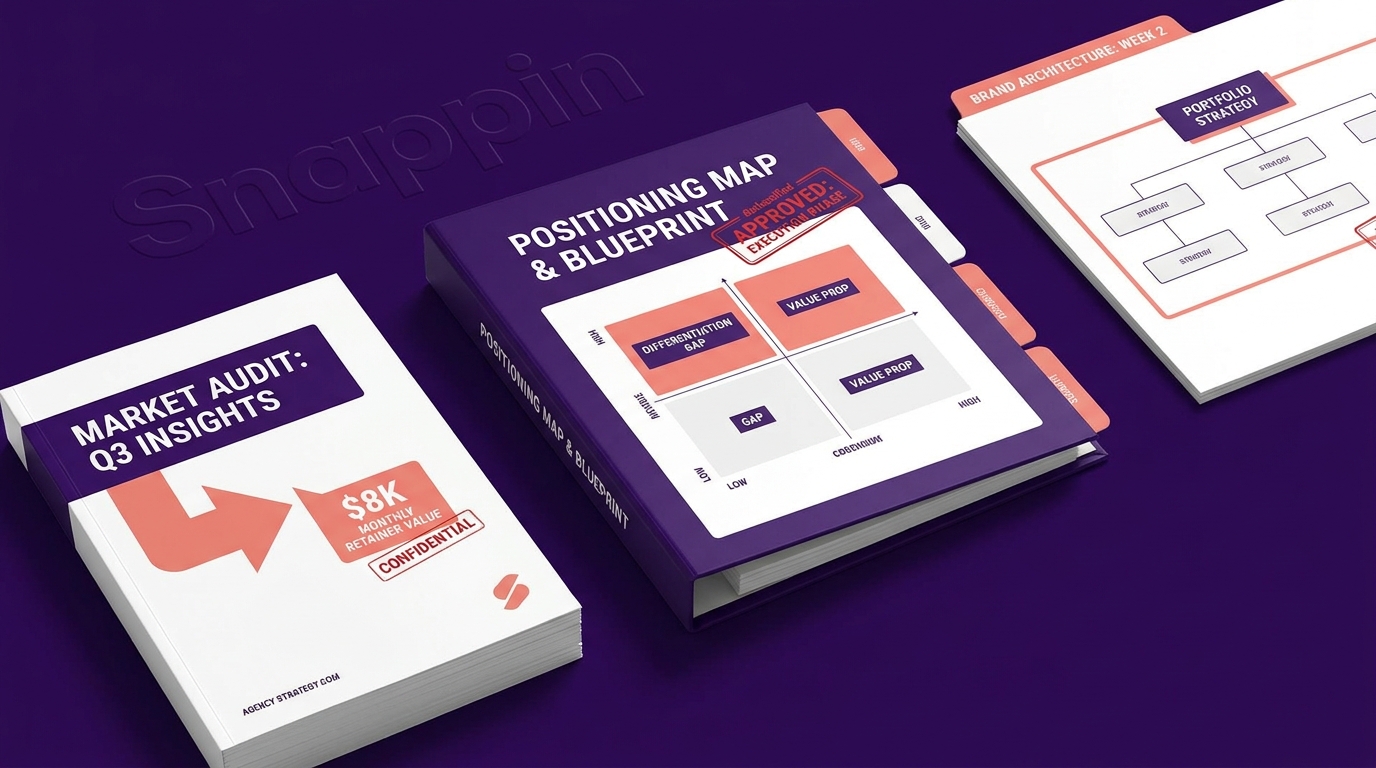
Brand Strategy Retainer: The Agency Deliverables You're Actually Paying For
A brand strategy retainer at $8k, $15k/month is built on five core deliverables: market research methodology, positioning framework, brand architecture, competitive analysis, and expression system. These are specific frameworks agencies have spent years productizing, rather than vague consulting hou