Strategy-First AI Marketing: What Sets Snappin Apart
TL;DR: Rather than a faster AI content generator, Snappin operates as a strategy-first AI marketing platform that builds your brand strategy first, then uses that strategy as the governing layer for every subsequent execution decision. That architectural choice creates a different category entirely, not simply a better version of what already exists.
Most AI marketing tools give you speed. Snappin gives you direction.
That distinction matters more than most founders realize, until they have spent months generating AI content that moved no one, built no brand, and converted no customers. According to HubSpot's 2024 State of Marketing Report, 63% of marketers identify generating traffic and leads as their top challenge, despite having access to more content tools than ever before. While the tools multiplied, the core problem remained.
This indicates a systemic category problem rather than a coincidence.
The Category Confusion Costing Founders Their Growth
The AI marketing tool market has expanded dramatically. According to Grand View Research, the global AI in marketing sector was valued at $15.84 billion in 2021 and is projected to grow at a compound annual rate of 26.7% through 2028. Yet growth in tool adoption has not translated into growth in marketing outcomes for most businesses.
Almost every AI marketing tool available today operates at the execution layer. They make execution faster, cheaper, and more scalable. They write captions. They generate email sequences. They repurpose blog content across channels. Fundamentally, they function as production accelerators.
Production acceleration produces volume rather than strategy.
Why More Content Without Strategy Makes the Problem Worse
When you give a founder without a clear marketing strategy a tool that generates ten times more content, the result is ten times more unfocused content.
According to the Content Marketing Institute, only 40% of B2B marketers have a documented content marketing strategy. That means the majority are accelerating execution without a strategic foundation to execute against. More output with no strategic direction does not compound. It dissipates.
The fundamental flaw is architectural. Most AI marketing tools were designed to solve a production problem: content creation takes too long and costs too much. They solved that problem. The actual challenge most founders face lies in achieving strategic clarity: knowing what to say, to whom, and why it matters to that specific person.
Why Do Most AI Marketing Tools Fail to Improve Marketing Outcomes?
Most AI marketing tools fail to improve marketing outcomes because they were built to solve the wrong problem. They treat marketing as a content production challenge when it represents a fundamental strategic communication challenge.
According to Forrester Research, only 15% of marketing leaders say their teams are effective at translating strategy into execution. This represents a strategy-to-execution translation gap rather than a content volume gap, and it persists regardless of how fast your content tool generates output.
When execution accelerates without strategic governance, the misalignment compounds at scale. You reach more people with content that fails to connect. Your brand becomes associated with noise rather than signal. Rebuilding that brand perception costs significantly more than building it correctly from the start.
Why Strategy-First AI Marketing Begins Where Others End
Every other AI marketing tool starts at the same place: the blank page. You open the platform, enter a prompt or a brief, and the tool generates content. The strategy (the positioning, the audience psychology, the brand voice, the competitive differentiation) is assumed to already exist inside your head.
Most founders lack this strategy in the structured, documented, executable form needed to govern content decisions.
Snappin begins where all other AI tools end: at the strategy layer.
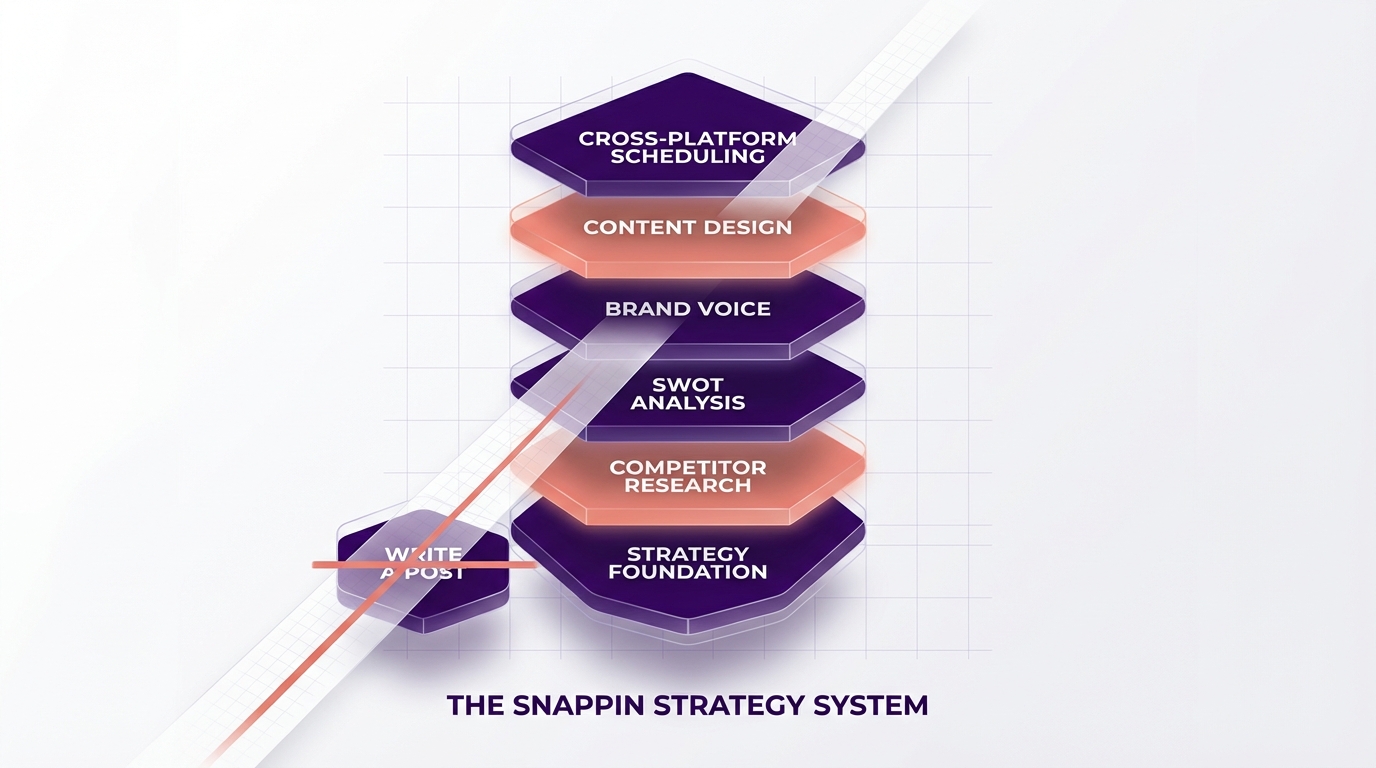
Before Snappin generates a single word of content, it builds a complete strategic foundation for your brand. This includes your market positioning, your ideal customer psychology, your brand voice architecture, your competitive differentiation, and your channel strategy. Rather than a static questionnaire you complete and abandon, that foundation serves as an active governing layer that every subsequent execution decision runs through.
According to Nielsen research, brands with consistent strategic messaging across channels see 23% higher revenue growth than brands with inconsistent messaging. Strategy-governed execution is what makes consistency possible at scale. Consistency is what builds compounding brand equity over time.
What Does 'Strategy Governs Execution' Actually Mean in AI Marketing?
"Strategy governs execution" serves as an architectural principle rather than a mere positioning line. It means that every content decision in Snappin is evaluated against a live strategic brief before it is generated.
When Snappin creates a social post, it avoids retrieving a prompt template to fill in blanks, instead making content decisions against your brand's strategic foundation: What is this brand's positioning in this market? What does this specific audience segment value? What tone reflects this brand's voice at this awareness stage? What strategic goal does this piece serve? The content that emerges from those questions is categorically different from content that emerges from a blank prompt.
According to the Ehrenberg-Bass Institute for Marketing Science, mental availability, how readily a brand comes to mind in relevant buying situations, is the primary driver of market share growth. Mental availability is built through consistent, strategically coherent messaging over time. Volume alone cannot build it. Only strategy-governed volume can.
What Makes Snappin Different From an AI Content Generation Tool?
Snappin differs from an AI content generation tool in the same way an architect differs from a construction crew. A construction crew builds faster and more efficiently, but what they build is determined by a blueprint that already exists. Snappin is the platform that creates the blueprint first, then executes against it with AI efficiency.
Most AI content tools assume the blueprint exists in your head. Snappin externalizes that blueprint into a codified strategic system. Every piece of content produced after that point is governed by the strategy, eliminating any guesswork.
According to a McKinsey Global Survey on AI adoption, companies that integrate AI into core strategic processes see productivity gains of 40% or more, compared to 15% for companies that use AI as a point solution for individual tasks. That gap is strategy integration, and it is precisely what Snappin was built to provide.
How Most AI Marketing Platforms Are Built Backward
Understanding why Snappin represents a new category requires understanding the architectural flaw in existing platforms. The flaw lies entirely in the design philosophy.
Most AI marketing tools were built to solve a production problem. The logic is linear and reasonable: content creation is slow and expensive → AI can generate content faster and cheaper → therefore, build an AI content generator. That logic is sound as far as it goes. The problem is that it does not go far enough.
Marketing functions as a strategic communication problem rather than a content production problem. The critical question focuses on how we say the right thing to the right person at the right moment in a way that builds both trust and urgency simultaneously.
According to HubSpot research, companies without a documented marketing strategy spend 43% more per lead than companies with one. AI tools that operate without strategic governance amplify this cost. This happens because the tools make it cheaper to produce misaligned content at higher volume.
Why Execution Without Strategy Always Plateaus
Here is a pattern that plays out consistently in founder-led businesses: a founder discovers an AI content tool, experiences a surge in productivity, publishes more content than ever before, and then watches engagement plateau while conversions remain flat. The tool performed exactly as designed. But faster production of strategically unfounded content creates a plateau faster, rather than slower.
According to Ahrefs research, the average top-ranking piece of content contains three times more strategy-driven topical depth than lower-ranking content on the same keyword. Strategic depth, authority, and consistency serve as the true ranking signals. You cannot accelerate your way to those outcomes without a strategy-first foundation underneath.
The founders who win in search, in social, and in direct response prioritize strategically coherent content, where every piece reinforces a clear brand position and builds on everything that came before it.
The Architecture of Strategy-First AI Marketing
What does a strategy-first AI marketing platform actually look like in practice? The architecture has three distinct layers. Understanding each one clarifies why the system produces fundamentally different outcomes from execution-layer tools.
Layer 1: The Strategic Foundation
This is where Snappin begins. Before any content is created, the platform constructs a comprehensive brand strategy document ; including market positioning (where you compete and why you win there), audience architecture (the psychological drivers, fears, aspirations, and language patterns of your ideal customer), brand voice guidelines (the specific tonal and linguistic parameters that make your brand recognizable), and competitive differentiation (what makes your brand genuinely distinct rather than generically better).
Layer 2: The Strategic Brief
Every content creation request in Snappin automatically contextualizes against your strategic foundation rather than presenting a blank prompt. The platform translates your strategy into a living brief that informs every content decision: channel, format, tone, message, call to action, and positioning angle before a single word is generated.
Layer 3: Strategy-Governed Execution
Only at this layer does content get generated, executing against a strategic brief rather than a blank template. Every resulting piece becomes strategically coherent. It builds on every previous piece. It speaks to the right audience in the right voice with the right message for the right moment in their journey.
How Does Snappin Build a Brand Strategy Before Creating Content?
Snappin builds a brand strategy through a structured discovery process that translates founder knowledge into codified strategic assets. The platform asks the right questions about your market, your customers, your differentiation, your goals, and uses AI to synthesize those inputs into a strategic foundation document that would cost between $15,000 and $75,000 to produce through a traditional marketing agency, according to the American Marketing Association.
That strategic document operates as a live system that informs every subsequent content decision. When your market context shifts or your positioning evolves, the strategy layer updates, and execution updates with it. The foundation adapts without requiring you to start from scratch.
What Strategy-First AI Marketing Looks Like in Practice
Abstract architecture tells only part of the story. The real test is what strategy-first AI marketing produces compared to standard AI content tools when applied to the same business context.
Consider two founders operating in the same industry, launching similar products.
Founder A uses a standard AI content tool. They create a profile, choose a content niche, and begin generating. Within a week, they have 30 social posts, 5 blog articles, and an email welcome sequence. Engagement is modest. Nothing measurably converts.
Founder B uses Snappin. Before creating a single piece of content, the platform maps their market positioning, identifies the psychological profile of their highest-value customer segment, and establishes a brand voice that reflects their specific expertise. Content creation begins in week two, but every piece is built against a strategic brief.
By month three, Founder B has half the content volume of Founder A and three times the audience engagement, with a measurable lead generation rate that makes marketing profitable rather than speculative. According to a Deloitte study, brands with clearly defined and consistently executed strategic positioning outperform category peers by 20% on revenue growth and 25% on profitability over a five-year period. The compounding advantage of strategic consistency is real, and it only materializes when strategy is the governing layer.
Is a Strategy-First AI Marketing Approach Right for Every Business?
A strategy-first approach is right for any business where marketing outcomes matter more than marketing volume. If the goal is simply to fill a content calendar, there are faster and cheaper tools available for that purpose.
If the goal is to build a brand that commands premium positioning, generates inbound demand, and converts at rates that make marketing a compounding asset rather than a recurring cost, a strategy-first approach provides the only architecture that produces those outcomes systematically, regardless of the channels or formats you choose.
[LINK: Snappin platform overview]
Why Strategy-First AI Marketing Is the Only Sustainable Path
Marketing has always had a durability problem. Tactics that work become saturated. Channels that convert become crowded. Algorithms change. Trends shift. The founders who build durable brands focus on building strategic foundations strong enough to adapt their tactics without losing their positioning.
Speed applied to a clear strategy is a genuine competitive advantage. Speed applied to unclear positioning is a faster way to go nowhere.
This is why the production speed most AI marketing tools offer is less valuable than most founders assume. The real bottleneck in founder marketing stems from clarity rather than time. Founders freeze in front of a blank page not because writing a caption takes too long, but because they lack certainty about what to say, to whom, or why it would matter to that specific person.
Snappin solves the actual bottleneck. When your strategy is codified and active in your marketing platform, the blank page disappears. You know what to say because your strategy tells you. You know who you are speaking to because your audience architecture defines them. You know why it matters because your positioning gives you the answer with specificity rather than approximation.
Why the Founder Marketing Problem Is Fundamentally a Strategy Problem
The mainstream conversation about founder marketing focuses persistently on time. Founders do not have enough time to create content, meaning the solution must be tools that create content faster. This framing remains incomplete in a way that keeps founders cycling through tool after tool without resolving the underlying problem.
According to research from the Content Marketing Institute, founders who operate with a documented content strategy are 3x more likely to report success with their marketing than those without one, regardless of which tools they use. The strategy serves as the determining variable.
When strategy is the governing layer of a marketing system, every tool becomes more effective, not just AI content tools, but email platforms, ad accounts, and SEO workflows. Strategy is a force multiplier for every subsequent execution effort. [LINK: brand strategy for founders]
The Future That Strategy-First AI Marketing Makes Inevitable
There is a version of the future where every founder (regardless of marketing budget, agency access, or professional background) has access to the same quality of strategic thinking that currently exists only inside the world's most successful brand-building organizations.
In that future, having a documented brand strategy transitions from a luxury for funded startups to the mandatory starting point for any founder who decides to take their marketing seriously. AI makes the execution efficient. Strategy makes the execution meaningful. The combination is what transforms marketing from a recurring cost into a compounding asset.
That future is not speculative. Snappin is building it now.
The current generation of AI marketing tools solved a real problem: production speed. They deserve credit for that contribution. But production speed was never the ceiling on what marketing could become. The ceiling was always strategy access: the ability to know not just how to create content, but what strategic purpose that content serves, what audience it was built for, and how it contributes to a brand narrative that builds over time.
When strategy governs execution, marketing stops being a cost center and starts becoming a compounding asset. Every piece of content reinforces the brand. Every campaign builds on the last. The audience you build remains yours, earned through consistent strategic communication over time rather than borrowed from an algorithm or rented from a platform.
That represents the categorical difference of Snappin. It is strategically governed.
Build the Foundation First: Your Next Three Steps
The argument this post has worked to demonstrate, rather than just assert, is that the category of "AI marketing tool" has been defined too narrowly. It has been defined by the execution layer when the real advantage exists at the strategy layer.
If you recognize your marketing in the patterns described here, if you have experienced the plateau that comes from volume without strategy, or felt the paralysis that comes from not knowing what to say, the next step involves building the strategic foundation that makes your content decisions clear and deliberate, rather than finding a faster content tool.
Here is where to start:
-
Audit your current marketing for strategic coherence. Read your last ten pieces of content as a stranger would. Is there consistent positioning? A recognizable voice? A clear audience? If the answer is unclear, you face a strategy problem rather than a content problem. [LINK: marketing audit guide]
-
Write your positioning sentence before your next content piece. Before creating anything else, write one sentence that describes who you serve, what you deliver for them, and what makes your approach genuinely distinct. This is the smallest viable version of a strategic foundation, and it changes every content decision you make afterward.
-
Explore Snappin as a strategy-first alternative. If you are ready to move from content generation to strategy-governed execution, Snappin was built for exactly this transition: for founders who are serious about building a brand, not just filling a calendar. [LINK: Snappin platform]
The future of marketing demands more strategic content: content that knows what it is trying to accomplish, who it is trying to reach, and how it fits into a brand narrative that compounds over time.
Strategy first. Always.
Snappin Team
Strategy-first marketing insights from the team building Snappin — the AI Marketing Copilot that combines strategy, content creation, and scheduling in one platform.
Try Snappin freeContinue Reading
Strategy-First Positioning: A Framework for Founders
If you've invested months in an agency relationship and still can't articulate what makes your brand genuinely different, that is a positioning problem. That distinction changes everything about how you solve it. The strategy-first positioning framework gives founders a structured path to build real

The Mechanics of Reach: A Strategic Guide to Social Media Algorithms
If you want consistent reach, stop looking for "viral hacks." Building a real brand on social media isn't about winning a lottery; it’s about understanding how the platforms actually work.
The Strategy Gap: Why Your Marketing Isn't Working
Most founders don't have a marketing problem. They have a marketing strategy gap. This is the absence of documented positioning, audience clarity, and messaging architecture before execution begins. Until that gap closes, more content, better tools, and bigger budgets will produce the same disappoin